• Can you help me interpret this spectrum analysis noise plot?

    From Danny D'Amico@danny@is.invalid to alt.home.repair,alt.internet.wireless,alt.ham-radio on Wed Dec 18 01:48:13 2013
    From Newsgroup: alt.ham-radio

    Can you help me interpret this 2.4GHz WiFi spectrum analysis noise plot
    that I just ran from my Ubiquiti Rocket M2 rooftop antenna?

    I'm trying to debug why I have -88dBm of noise at my rooftop radio.

    My Rocket M2 rooftop radio is on channel 10.
    My home broadband router inside the house is on channel 1.

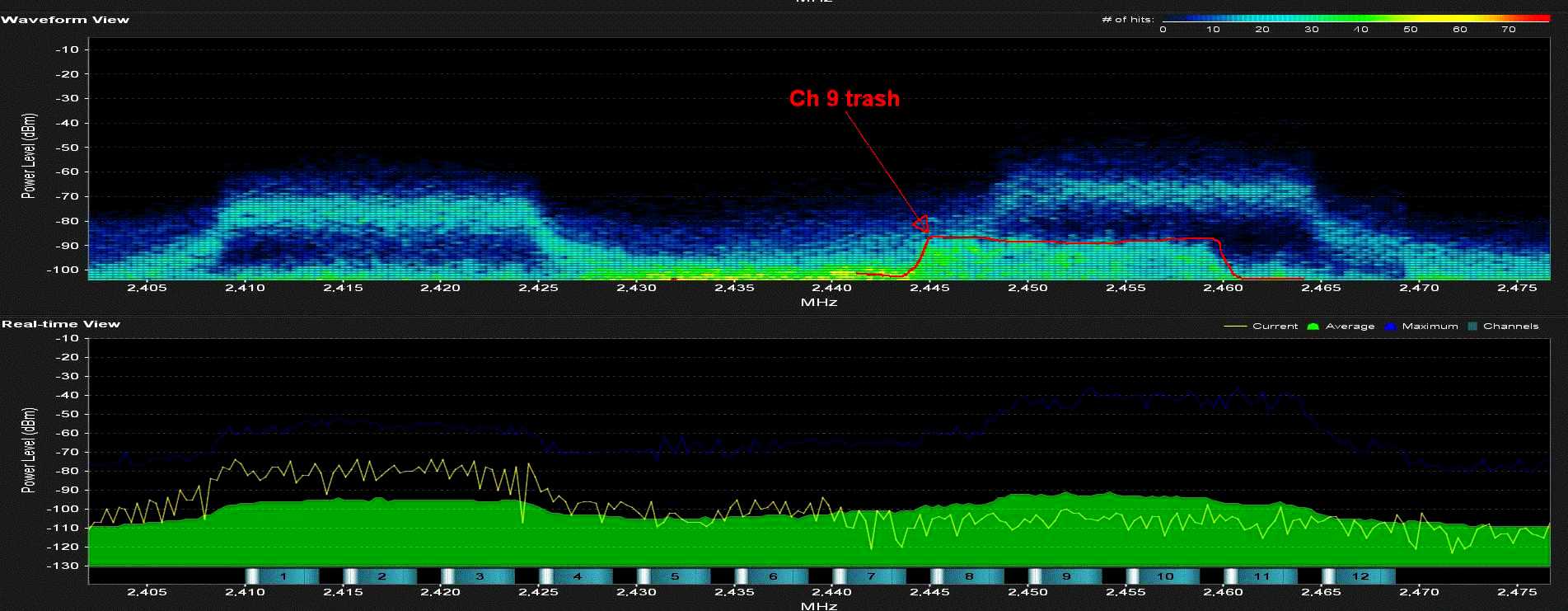
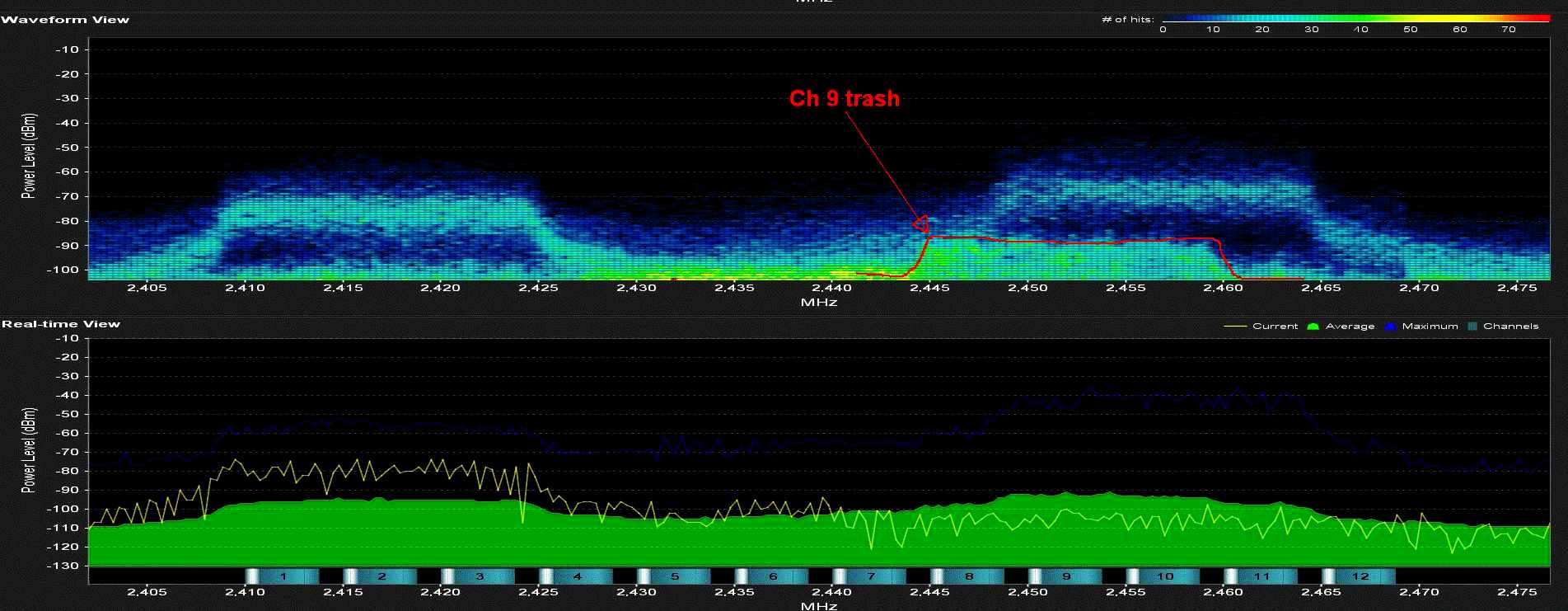
    Here is the "waterfall" plot:
    http://farm8.staticflickr.com/7299/11427414296_de48f3922e_o.jpg

    Here is the "channel" plot:
    http://farm8.staticflickr.com/7310/11427413806_21e93b109b_o.jpg

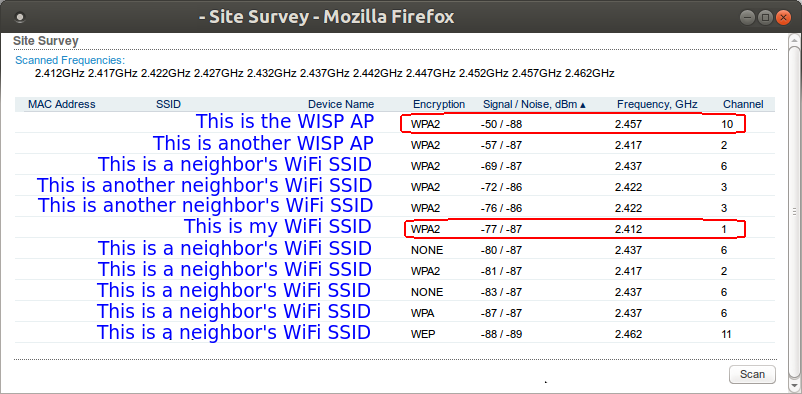
    Here's a site survey:
    http://farm6.staticflickr.com/5484/11427682854_0332590c4f_o.png

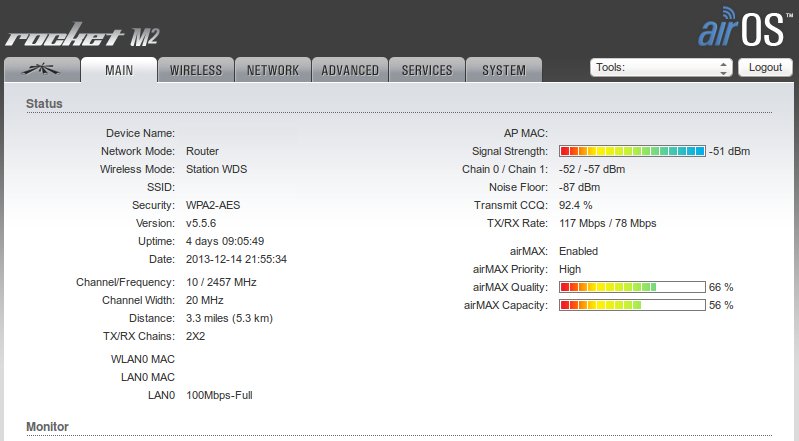
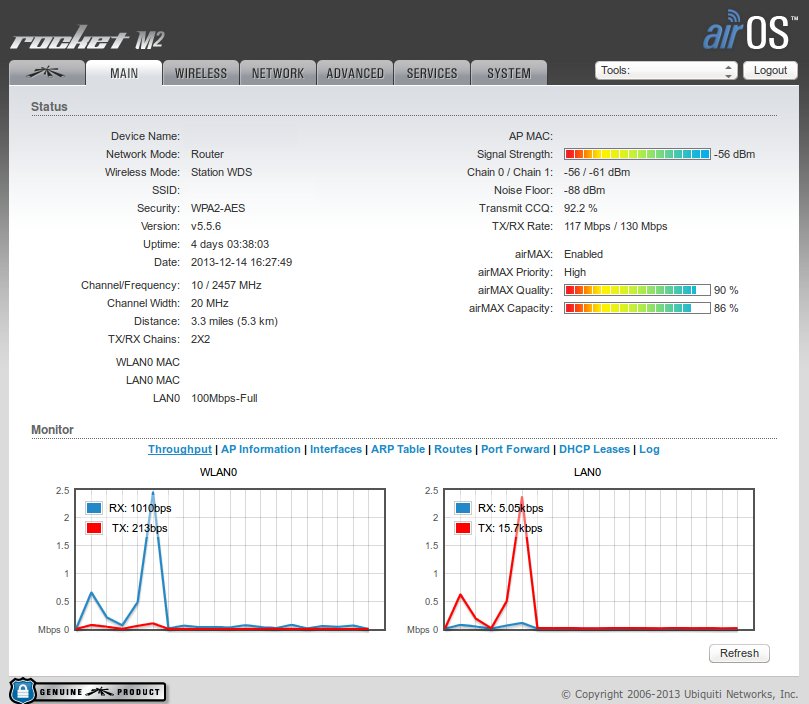
    And, here's a view of the rooftop radio signal to noise strength:
    http://farm8.staticflickr.com/7380/11427771814_de0692ea50_o.png

    Any observations with respect to the source of the -88dB noise?
    (I don't really know how to interpret this stuff.)

    --- Synchronet 3.21b-Linux NewsLink 1.2
  • From hh@hh@kk.org to alt.home.repair,alt.internet.wireless,alt.ham-radio on Wed Dec 18 02:21:53 2013
    From Newsgroup: alt.ham-radio

    Danny D'Amico <danny@is.invalid> wrote in news:pan.2013.12.18.01.48.13 @is.invalid:

    Can you help me interpret this 2.4GHz WiFi spectrum analysis noise plot
    that I just ran from my Ubiquiti Rocket M2 rooftop antenna?

    I'm trying to debug why I have -88dBm of noise at my rooftop radio.

    My Rocket M2 rooftop radio is on channel 10.
    My home broadband router inside the house is on channel 1.

    Here is the "waterfall" plot:
    http://farm8.staticflickr.com/7299/11427414296_de48f3922e_o.jpg

    Here is the "channel" plot:
    http://farm8.staticflickr.com/7310/11427413806_21e93b109b_o.jpg

    Here's a site survey:
    http://farm6.staticflickr.com/5484/11427682854_0332590c4f_o.png

    And, here's a view of the rooftop radio signal to noise strength:
    http://farm8.staticflickr.com/7380/11427771814_de0692ea50_o.png

    Any observations with respect to the source of the -88dB noise?
    (I don't really know how to interpret this stuff.)


    only guy who can do this is gone, Jeff Liebermann

    --- news://freenews.netfront.net/ - complaints: news@netfront.net ---
    --- Synchronet 3.21b-Linux NewsLink 1.2
  • From Danny D'Amico@danny@is.invalid to alt.home.repair,alt.internet.wireless,alt.ham-radio on Wed Dec 18 03:32:31 2013
    From Newsgroup: alt.ham-radio

    On Tue, 17 Dec 2013 18:42:50 -0800, makolber wrote:

    So what's the problem?
    How much noise would you consider normal?
    Thermal noise is -174 dBm per Hz
    What's the bandwidth and noise figure of your receiver?
    Mark

    Q: What's the problem.
    A: It's my understanding that every dB of noise reduces the dB of signal
    by that amount. The less signal, the slower the Internet speeds.

    Q: How much noise do you consider normal?
    A: I have no idea. That's why I'm asking! :) Googling, I find you "should"
    have about 20dB of headroom between noise & signal. My signal is about
    -52dBm and my noise is -88dBm, so I'm within that range, but, my
    signal to noise ratio is -52dBm - -88dBm = 36

    Q: What's the bandwidth & noise figure of your receiver?
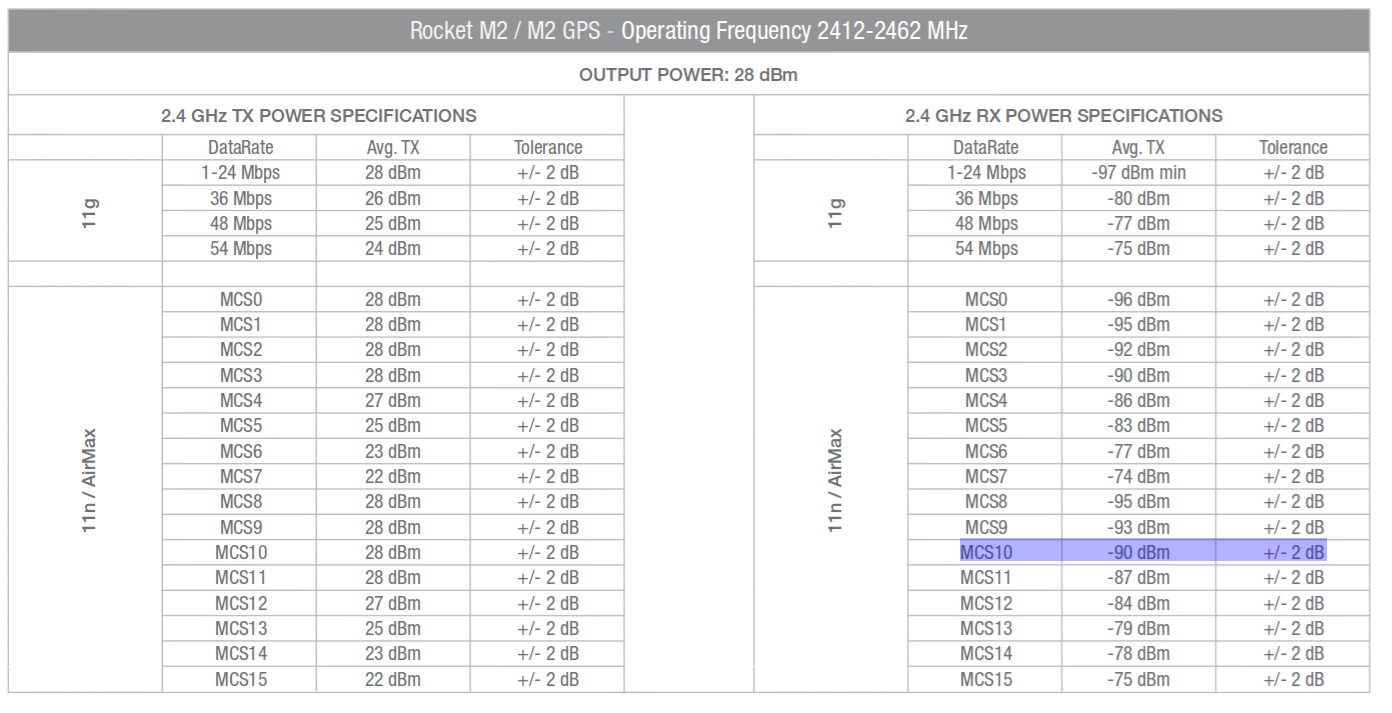
    A: Googling for the "Rocket M2 bandwidth gain specifications", I find
    this datasheet for a "RM2" receiver & "2G-24" 24dBi dish reflector:
    http://www.balticnetworks.com/docs/rm_ds_web.pdf
    Which says, on page 6:
    Rocket M2, Operating Frequency 2412-2462 MHz
    2.4 GHz RX POWER SPECIFICATIONS
    llg = 1-24 Mbps => -97 dBm min +/- 2 dB
    11g = 36 Mbps => -80 dBm +/- 2 dB
    11g = 48 Mbps => -77 dBm +/- 2 dB
    11g = 54 Mbps => -75 dBm +/- 2 dB
    11n = MCS0 => -96 dBm +/- 2 dB
    11n = MCS1 => -95 dBm +/- 2 dB
    11n = MCS2 => -92 dBm +/- 2 dB
    11n = MCS3 => -90 dBm +/- 2 dB
    11n = MCS4 => -86 dBm +/- 2 dB
    11n = MCS5 => -83 dBm +/- 2 dB
    11n = MCS6 => -77 dBm +/- 2 dB
    11n = MCS7 => -74 dBm +/- 2 dB
    11n = MCS8 => -95 dBm +/- 2 dB
    11n = MCS9 => -93 dBm +/- 2 dB
    11n = MCS10 => -90 dBm +/- 2 dB <=== this is my channel
    11n = MCS11 => -87 dBm +/- 2 dB
    11n = MCS12 => -84 dBm +/- 2 dB
    11n = MCS13 => -79 dBm +/- 2 dB
    11n = MCS14 => -78 dBm +/- 2 dB
    11n = MCS15 => -75 dBm +/- 2 dB

    Given that my Rocket M2 is 11n MIMO, and on channel 10, I'd say
    the receiver sensitivity is from -88 to -92 dBm.

    Hmmm... I just noticed, that this is the same (essentially) as
    my noise figure. But, I'm not sure what that tells me.

    --- Synchronet 3.21b-Linux NewsLink 1.2
  • From Jeff Liebermann@jeffl@cruzio.com to alt.home.repair,alt.internet.wireless,alt.ham-radio on Tue Dec 17 19:32:34 2013
    From Newsgroup: alt.ham-radio

    On Wed, 18 Dec 2013 02:21:53 +0000 (UTC), hh <hh@kk.org> wrote:

    only guy who can do this is gone, Jeff Liebermann

    Rumors of my demise might be a bit premature. I'm buried in projects,
    work, Christmas Chrisis', ladyfriend, and trying to untrash my house,
    office, and vehicle. Incidentally, this is what I've been doing for
    "fun".
    <http://www.learnbydestroying.com/jeffl/antennas/dish-move-project/>
    --
    Jeff Liebermann jeffl@cruzio.com
    150 Felker St #D http://www.LearnByDestroying.com
    Santa Cruz CA 95060 http://802.11junk.com
    Skype: JeffLiebermann AE6KS 831-336-2558
    --- Synchronet 3.21b-Linux NewsLink 1.2
  • From Danny D'Amico@danny@is.invalid to alt.home.repair,alt.internet.wireless,alt.ham-radio on Wed Dec 18 03:34:16 2013
    From Newsgroup: alt.ham-radio

    On Tue, 17 Dec 2013 19:32:34 -0800, Jeff Liebermann wrote:

    Incidentally, this is what I've been doing for fun".

    Hi Jeff,

    Ooooh. Yours is bigger than mine!

    That looks like a neat project.

    Well, I'm here in the Santa Cruz mountains, just trying to figure
    out what my noise plot is trying to tell me (I'm on channel 10):
    http://farm8.staticflickr.com/7299/11427414296_de48f3922e_o.jpg

    --- Synchronet 3.21b-Linux NewsLink 1.2
  • From Danny D'Amico@danny@is.invalid to alt.home.repair,alt.internet.wireless,alt.ham-radio on Wed Dec 18 03:44:39 2013
    From Newsgroup: alt.ham-radio

    On Wed, 18 Dec 2013 03:32:31 +0000, Danny D'Amico wrote:

    Q: What's the bandwidth & noise figure of your receiver?

    Here's a better screenshot of the bandwidth numbers, without the
    text formatting that went on by my newsreader client:
    http://farm4.staticflickr.com/3816/11429039175_58d8e8f5a1_o.png

    Since my Rocket M2 radio is on channel 10, it looks like the
    sensitivity is from -88dBm to -92dBm.

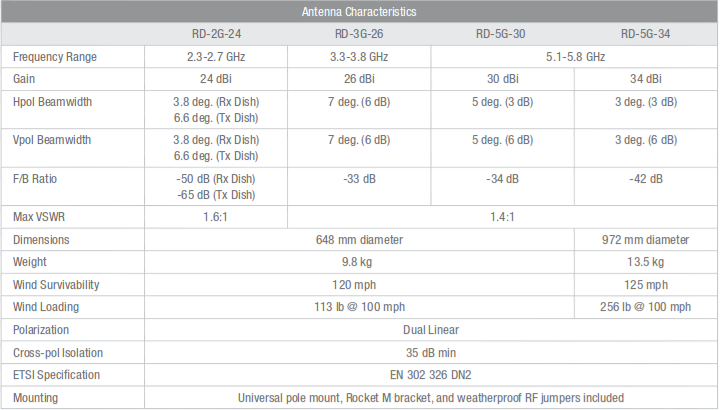
    The 24dBi antenna has specifications here:
    http://www.balticnetworks.com/ubiquiti-rocketdish-2g-24-airmax-dish-antenna.html
    Which say:
    • Frequency Range: 2.3-2.7 GHz
    • Gain: 24 dBi
    • Hpol Beamwidth: 3.8 deg. (Rx Dish) / 6.6 deg. (Tx Dish)
    • Vpol Beamwidth: 3.8 deg. (Rx Dish) / 6.6 deg. (Tx Dish)
    • F/B Ratio: -50 dB (Rx Dish) / -65 dB (Tx Dish)
    • Max VSWR: 1.6:1
    • Polarization: Dual Linear
    • Cross-pol: Isolation 35 dB min

    The Rocketdish RD-2G24 datasheet is here:
    http://www.balticnetworks.com/docs/rd_ds_web.pdf
    which shows these specifications:
    http://farm4.staticflickr.com/3777/11429124446_44327f43fb_o.png

    So, in summary, the 24dBi dish has a narrow bandwidth of 3.8° to 6.8° degrees, and the receiver has a sensitivity of -90dBm ±2dB.

    I don't know how to translate those facts into an interpretation of
    the spectrum analysis noise charts provided in the OP though.

    --- Synchronet 3.21b-Linux NewsLink 1.2
  • From Tony Hwang@dragon40@shaw.ca to alt.home.repair,alt.internet.wireless,alt.ham-radio on Tue Dec 17 21:19:40 2013
    From Newsgroup: alt.ham-radio

    Danny D'Amico wrote:
    On Tue, 17 Dec 2013 18:42:50 -0800, makolber wrote:

    So what's the problem?
    How much noise would you consider normal?
    Thermal noise is -174 dBm per Hz
    What's the bandwidth and noise figure of your receiver?
    Mark

    Q: What's the problem.
    A: It's my understanding that every dB of noise reduces the dB of signal
    by that amount. The less signal, the slower the Internet speeds.

    Q: How much noise do you consider normal?
    A: I have no idea. That's why I'm asking! :) Googling, I find you "should"
    have about 20dB of headroom between noise & signal. My signal is about
    -52dBm and my noise is -88dBm, so I'm within that range, but, my
    signal to noise ratio is -52dBm - -88dBm = 36

    Q: What's the bandwidth & noise figure of your receiver?
    A: Googling for the "Rocket M2 bandwidth gain specifications", I find
    this datasheet for a "RM2" receiver & "2G-24" 24dBi dish reflector:
    http://www.balticnetworks.com/docs/rm_ds_web.pdf
    Which says, on page 6:
    Rocket M2, Operating Frequency 2412-2462 MHz
    2.4 GHz RX POWER SPECIFICATIONS
    llg = 1-24 Mbps => -97 dBm min +/- 2 dB
    11g = 36 Mbps => -80 dBm +/- 2 dB
    11g = 48 Mbps => -77 dBm +/- 2 dB
    11g = 54 Mbps => -75 dBm +/- 2 dB
    11n = MCS0 => -96 dBm +/- 2 dB
    11n = MCS1 => -95 dBm +/- 2 dB
    11n = MCS2 => -92 dBm +/- 2 dB
    11n = MCS3 => -90 dBm +/- 2 dB
    11n = MCS4 => -86 dBm +/- 2 dB
    11n = MCS5 => -83 dBm +/- 2 dB
    11n = MCS6 => -77 dBm +/- 2 dB
    11n = MCS7 => -74 dBm +/- 2 dB
    11n = MCS8 => -95 dBm +/- 2 dB
    11n = MCS9 => -93 dBm +/- 2 dB
    11n = MCS10 => -90 dBm +/- 2 dB <=== this is my channel
    11n = MCS11 => -87 dBm +/- 2 dB
    11n = MCS12 => -84 dBm +/- 2 dB
    11n = MCS13 => -79 dBm +/- 2 dB
    11n = MCS14 => -78 dBm +/- 2 dB
    11n = MCS15 => -75 dBm +/- 2 dB

    Given that my Rocket M2 is 11n MIMO, and on channel 10, I'd say
    the receiver sensitivity is from -88 to -92 dBm.

    Hmmm... I just noticed, that this is the same (essentially) as
    my noise figure. But, I'm not sure what that tells me.

    Hi,
    First do you understand what decibel means in the context of voltage,
    current or power? Can you calcualte receiver sensitivity of -92dbm
    comes out (?) volts? On what modulation mode are we talking about?
    --- Synchronet 3.21b-Linux NewsLink 1.2
  • From Danny D'Amico@danny@is.invalid to alt.home.repair,alt.internet.wireless,alt.ham-radio on Wed Dec 18 04:26:26 2013
    From Newsgroup: alt.ham-radio

    On Wed, 18 Dec 2013 03:44:39 +0000, Danny D'Amico wrote:

    I don't know how to translate those facts into an interpretation of the spectrum analysis noise charts provided in the OP though.

    Googling, I can make a guess that my transient noise (blue line) is very
    high at channel 10 of -40dBm, but that my average noise (green line) is
    very very low at -90dBm.

    The receiver sensitivity that someone asked me to look up is at about
    my average noise level, at -90dBm ± 2dB for 802.11n signals.

    So, the question I ask, without having the experience to know what "good" transient noise and average noise levels are, is whether or not these
    numbers are "good" or "average" or "bad"?

    Also, I have no experience whether a peak instantaneous noise of -40dBm
    (which is admittedly high) has any detrimental effect on my radio
    performance (even as the average seems very low, at -90dBm).

    I just don't know. Do you?
    http://farm8.staticflickr.com/7299/11427414296_de48f3922e_o.jpg


    --- Synchronet 3.21b-Linux NewsLink 1.2
  • From Danny D'Amico@danny@is.invalid to alt.home.repair,alt.internet.wireless,alt.ham-radio on Wed Dec 18 04:53:32 2013
    From Newsgroup: alt.ham-radio

    On Tue, 17 Dec 2013 21:19:40 -0700, Tony Hwang wrote:

    First do you understand what decibel means in the context of voltage,
    current or power? Can you calcualte receiver sensitivity of -92dbm
    comes out (?) volts? On what modulation mode are we talking about?

    I (think I) do understand decibels, at least at a rudimentary level.
    Here's my simple summary of how I organize my thoughts around decibels:

    1) Every 3 decibels is a doubling (or halving) of power.
    2) A halving of power would be if it went from -87dBm to -90dBm.
    3) My radio is transmits at 27 decibels (compared to the mW reference).
    4) When I want to convert dBm to Watts, I google "dbm to watts".
    5) The first hit is always the best dbm-to-Watts converter.
    6) http://www.rapidtables.com/convert/power/dBm_to_Watt.htm
    7) So, 27 dBm is 1/2 Watt (Note: 30 dBm would be 1 Watt, & so on).
    8) The receiver is sensitive to -90dBm at 802.11n channel 10.
    9) That means it can pick up a signal strength of 1 picowatt.
    10) The signal to noise headroom needs to be around 20dBm.
    11) That means I need signal to be 1/10 Watt greater than noise.
    12) The transmitter is claimed to be 28dBm±2dB at channel 10.
    13) So, the transmitter (without antenna) is 6/10ths of a Watt.
    14) However, the Rocketdish reflector & antenna add another 24dBi.
    15) A dBi is relative to a fictional spherical-radiation pattern.
    16) So, my effective isotropic radiated power is 28+24=52dBm!
    17) An EIRP of 52 dBm is a whopping 158 Watts!
    18) The FCC only allows me an effective power of 4 Watts
    19) Googling for "watts to dbm", the first link is the best.
    20) http://www.rapidtables.com/convert/power/Watt_to_dBm.htm
    21) That 4 Watts is 36dBm
    22) Even though the equipment is capable of 52dBm, it's toned
    down to that legal limit of 36dBm.

    So, given all that, my average noise is rather low, on channel 10,
    of about -90dBm or 1 picoWatt (which is the green part of the bottom
    graph below).
    http://farm8.staticflickr.com/7299/11427414296_de48f3922e_o.jpg

    However, my instantaneous noise is rather high, at -40dBm or
    10 microWatts (which is the blue line in the bottom graph above).

    So, I guess my question is how much will my radio be adversely affected
    by 10 microWatts of instantaneous noise, when the average noise is only
    1 picoWatt?

    I have no experience with what noise levels are good, and which ones
    are bad - so I have no background to interpret the spectrum analysis.

    REFERENCE:
    Transceiver datasheet (Ubiquiti Rocket M2):
    https://www.discomp.cz/img.asp?attid=88929

    Antenna (Ubiquiti Rocketdish RD-2G-24):
    http://dl.ubnt.com/datasheets/rocketdish/rd_ds_web.pdf

    --- Synchronet 3.21b-Linux NewsLink 1.2
  • From Danny D'Amico@danny@is.invalid to alt.home.repair,alt.internet.wireless,alt.ham-radio on Wed Dec 18 05:10:15 2013
    From Newsgroup: alt.ham-radio

    On Tue, 17 Dec 2013 21:19:40 -0700, Tony Hwang wrote:

    Can you calcualte receiver sensitivity of -92dbm
    comes out (?) volts?

    I never deal with volts when I'm working with the radio.
    I always deal in power. So, I don't know what the volts are,
    but, I do know this about -92dBm:

    0) First, I always google "dbm to watts".
    1) The first hit is always a great time-saving calculator.
    2) That's http://www.rapidtables.com/convert/power/dBm_to_Watt.htm .
    3) So, -92dBm is about 631 femtoWatts (which is pretty small).
    4) I don't know how to convert that to volts though.

    On what modulation mode are we talking about?

    I'm not sure if I understand the question, but, the radio operates
    in the 802.11n MIMO channel 10 (with vertical & horizontally polarized antennas) that have a 3.8° to 6.8° beamwidth (which is pretty narrow).

    NOTE: The narrow beamwidth is how the antenna gets all that gain in
    the first place. You can't create or destroy power, so, I'd have a
    wider beamwidth with a lower-gain antenna. This is a pretty high-gain
    antenna, so, the beam width is pretty narrow, but, since it's pointed
    at the WISP access point a few miles away, it doesn't have to be broad.

    --- Synchronet 3.21b-Linux NewsLink 1.2
  • From Danny D'Amico@danny@is.invalid to alt.home.repair,alt.internet.wireless,alt.ham-radio on Wed Dec 18 05:41:25 2013
    From Newsgroup: alt.ham-radio

    On Wed, 18 Dec 2013 05:10:15 +0000, Danny D'Amico wrote:

    NOTE: The narrow beamwidth is how the antenna gets all that gain in the
    first place.

    I didn't explain that one all too well.

    Here's another try at my thought process:

    1. If I put the legal limit of 4 Watts into an antenna with a wide
    radiation pattern, it goes only so far.
    2. If I then change the antenna pattern to be more narrow, the
    radiated signal goes farther in the direction that it is pointed.

    So, my antenna & dish reflector, having a gain of 24dBi, is pretty
    narrow at around 5° beamwidth (in both horizontal & vertical planes).

    Breaking out my trig (SOH, CAH, TOA), I see that I can create a right
    triangle of half the 5° beamwidth, with the Adjacent being 3 miles.

    Since I have the angle and the Adjacent, and I want the Opposite,
    it looks like the tangent will tell me the how large of a circle is
    painted on the WISP antenna 3 miles away.

    1. TOA means Tangent is equal to the Opposite over the Adjacent.
    2. So the Adjacent times the tangent is the Opposite.
    3. 3 miles time the tangent of 2.5° is what I need to know.
    4. Googling for "tangent calculator", again I take the first hit.
    5. That's http://www.rapidtables.com/calc/math/Tan_Calculator.htm .
    6. The tangent of 2.5° = 0.04366094 .
    7. So 3 miles x 0.04 is about 633 feet.
    8. The 2.5° was half the beamwidth (to make a right triangle).
    9. So the beam paints a pattern twice that, at about 1200 feet.
    10. This tells me that a beamwidth of 5° isn't really all that narrow!

    Note: The 5° is defined, I think, by where the furthest lobe's power
    is cut in half (i.e., by 3dB).

    Here is a picture of that pattern from the Rocketdish RD-2G-24:
    http://farm3.staticflickr.com/2890/11430271156_9d854acbb9_o.png

    Notice that this radio is pretty directional, but even so, I have
    a catcher's mitt about 1200 feet wide to hit my access point.

    Here are the Internet speeds I get by hitting that catcher's mitt:
    http://farm4.staticflickr.com/3743/11399640063_f0187217bd_o.png

    All I'm trying to do is *improve* on those Internet speeds, by
    understanding first, and then lowering my noise (or raising my
    signal-to-noise levels) within legal limits of 36 decibels EIRP.

    REFERENCE:
    http://dl.ubnt.com/datasheets/rocketdish/rd_ds_web.pdf

    --- Synchronet 3.21b-Linux NewsLink 1.2
  • From Tony Hwang@dragon40@shaw.ca to alt.home.repair,alt.internet.wireless,alt.ham-radio on Wed Dec 18 00:21:46 2013
    From Newsgroup: alt.ham-radio

    Danny D'Amico wrote:
    On Tue, 17 Dec 2013 21:19:40 -0700, Tony Hwang wrote:

    First do you understand what decibel means in the context of voltage,
    current or power? Can you calcualte receiver sensitivity of -92dbm
    comes out (?) volts? On what modulation mode are we talking about?

    I (think I) do understand decibels, at least at a rudimentary level.
    Here's my simple summary of how I organize my thoughts around decibels:

    1) Every 3 decibels is a doubling (or halving) of power.
    2) A halving of power would be if it went from -87dBm to -90dBm.
    3) My radio is transmits at 27 decibels (compared to the mW reference).
    4) When I want to convert dBm to Watts, I google "dbm to watts".
    5) The first hit is always the best dbm-to-Watts converter.
    6) http://www.rapidtables.com/convert/power/dBm_to_Watt.htm
    7) So, 27 dBm is 1/2 Watt (Note: 30 dBm would be 1 Watt, & so on).
    8) The receiver is sensitive to -90dBm at 802.11n channel 10.
    9) That means it can pick up a signal strength of 1 picowatt.
    10) The signal to noise headroom needs to be around 20dBm.
    11) That means I need signal to be 1/10 Watt greater than noise.
    12) The transmitter is claimed to be 28dBm±2dB at channel 10.
    13) So, the transmitter (without antenna) is 6/10ths of a Watt.
    14) However, the Rocketdish reflector & antenna add another 24dBi.
    15) A dBi is relative to a fictional spherical-radiation pattern.
    16) So, my effective isotropic radiated power is 28+24=52dBm!
    17) An EIRP of 52 dBm is a whopping 158 Watts!
    18) The FCC only allows me an effective power of 4 Watts
    19) Googling for "watts to dbm", the first link is the best.
    20) http://www.rapidtables.com/convert/power/Watt_to_dBm.htm
    21) That 4 Watts is 36dBm
    22) Even though the equipment is capable of 52dBm, it's toned
    down to that legal limit of 36dBm.

    So, given all that, my average noise is rather low, on channel 10,
    of about -90dBm or 1 picoWatt (which is the green part of the bottom
    graph below).
    http://farm8.staticflickr.com/7299/11427414296_de48f3922e_o.jpg

    However, my instantaneous noise is rather high, at -40dBm or
    10 microWatts (which is the blue line in the bottom graph above).

    So, I guess my question is how much will my radio be adversely affected
    by 10 microWatts of instantaneous noise, when the average noise is only
    1 picoWatt?

    I have no experience with what noise levels are good, and which ones
    are bad - so I have no background to interpret the spectrum analysis.

    REFERENCE:
    Transceiver datasheet (Ubiquiti Rocket M2):
    https://www.discomp.cz/img.asp?attid=88929

    Antenna (Ubiquiti Rocketdish RD-2G-24):
    http://dl.ubnt.com/datasheets/rocketdish/rd_ds_web.pdf

    Hi,
    When you talk about noise there are many different kinda noise.

    --- Synchronet 3.21b-Linux NewsLink 1.2
  • From Danny D'Amico@danny@is.invalid to alt.home.repair,alt.internet.wireless,alt.ham-radio on Wed Dec 18 08:12:30 2013
    From Newsgroup: alt.ham-radio

    On Wed, 18 Dec 2013 00:21:46 -0700, Tony Hwang wrote:

    When you talk about noise there are many different kinda noise.

    In the case here, it's all 2.4GHz signals which are not coming
    from the access point that I'm connecting to, yet, which the
    rooftop antenna sees.

    --- Synchronet 3.21b-Linux NewsLink 1.2
  • From Danny D'Amico@danny@is.invalid to alt.home.repair,alt.internet.wireless,alt.ham-radio on Wed Dec 18 08:28:49 2013
    From Newsgroup: alt.ham-radio

    On Tue, 17 Dec 2013 22:40:14 -0800, miso wrote:

    First things first. I'm guessing your WISP picked channel 10 and you can't change that. Is that the case?

    Yes.
    http://farm8.staticflickr.com/7299/11427414296_de48f3922e_o.jpg

    A waterfall is just time dependent sniffing. If your WISP wasn't spraying
    you with wifi on channel 10 (again, my guess), you would examine the waterfall display and find the area with the least activity. Now the waterfall is useful if someone burps wifi at you, as in a telemetry application. If the band was crowded, you would pick the channel with the occasional belch of wifi rather than one that is busy all the time. [If
    you were doing SIGINT, you would look for patterns in the occasional wifi belch. This is knows as traffic analysis.]

    It's rare to see time on the Y axis, so I see how it's time-dependent
    sniffing. I guess it also looks like a waterfall, since it's columnar
    but in layers. Blue seems to be where I'd want to be, if I wasn't
    constrained to be on channel 10, which is my access point channel.

    My next guess is you WISP provider has a customer on channel 2 at the same location that feeds you. [It could be another WISP from a different
    vendor.] The WISP provider has a beam antennas at the transmitter site.
    One beam for you on channel 10, another beam for somebody else on channel
    2.

    You are correct. The same WISP is feeding two different neighborhoods with
    two antennas, both at the same mast, one on channel 2 and the other on
    channel 10.

    I can now see the waterfall is yellow'er on those two channels, as are the power levels bluer, and the real-time view greener.

    That person may live near you since you are seeing the signal, but
    there are no red blobs in the waterfall, so the antenna isn't pointed directly at you. [And why would it be?] Red means a strong signal. The
    WISP on channel 2 is only 7 db less than your signal, but channel 2 and channel 10 have no common frequencies, so nothing to worry about.

    You figured out a lot from that waterfall graph that I hadn't mentioned (because I didn't realize it might be relevant). Yes, the WISP is on both channel 2 and 10, and both antennas are on the same tower; but only one (channel 10) is meant for me to connect to.

    You have two neighbors on channel 3, so that would be a bad channel for
    you, as would any channel that overlaps channel 3. Probably the WISP installer already knew that from when the site survey was done.

    The point is duly noted to stay away from channel 3.
    h
    I'm not really sure how they determine the noise floor. At any one time, there is somebody on a wifi channel. It might be really low RF level, but
    not zero. Probably the receiver makes a determination that if it can't
    sniff a signal, it must be noise. Not a good assumption.

    I think anything the antenna sees which is not a connection signal,
    is considered noise.

    At -50dBm over 3 miles, I'd call it a day and go looking for something
    else to fix.

    You have a point that the -50dBm isn't bad for a distance of 3 miles.
    I was more worried about the -88dBm of noise, but, now, after looking
    further, I think that the noise level is just about at the receiver
    sensitivity of -90dBm ± 2dB.

    The main figure that worries me is the instantaneous noise of -40dBm.
    Do you know what effect this instantaneous noise might have on the radio?

    --- Synchronet 3.21b-Linux NewsLink 1.2
  • From mike@ham789@netzero.net to alt.home.repair,alt.internet.wireless,alt.ham-radio on Wed Dec 18 01:51:40 2013
    From Newsgroup: alt.ham-radio

    On 12/18/2013 12:12 AM, Danny D'Amico wrote:
    On Wed, 18 Dec 2013 00:21:46 -0700, Tony Hwang wrote:

    When you talk about noise there are many different kinda noise.

    In the case here, it's all 2.4GHz signals which are not coming
    from the access point that I'm connecting to, yet, which the
    rooftop antenna sees.

    Would wrapping the feed in tinfoil give a measure of internally
    generated noise?
    --- Synchronet 3.21b-Linux NewsLink 1.2
  • From Danny D'Amico@danny@is.invalid to alt.home.repair,alt.internet.wireless,alt.ham-radio on Wed Dec 18 14:09:14 2013
    From Newsgroup: alt.ham-radio

    On Wed, 18 Dec 2013 01:51:40 -0800, mike wrote:

    Would wrapping the feed in tinfoil give a measure of internally
    generated noise?

    They do sell RF Armor for the Rocketdish, but, it's prohibitively expensive:
    http://www.rfarmor.com/cart/index.php?main_page=index&cPath=1

    I guess I could fabricate the RF Armor out of steel sheathing.
    http://www.youtube.com/watch?feature=player_detailpage&v=frPMnc1rW_o#t=58

    That would make it a neat home-repair project!
    http://www.youtube.com/watch?feature=player_detailpage&v=pn7ev2NnXr0#t=38

    --- Synchronet 3.21b-Linux NewsLink 1.2
  • From Char Jackson@none@none.invalid to alt.home.repair,alt.internet.wireless,alt.ham-radio on Wed Dec 18 10:07:41 2013
    From Newsgroup: alt.ham-radio

    On Wed, 18 Dec 2013 08:28:49 +0000 (UTC), Danny D'Amico <danny@is.invalid> wrote:

    I think anything the antenna sees which is not a connection signal,
    is considered noise.

    One receiver's signal is another receiver's noise.

    --- Synchronet 3.21b-Linux NewsLink 1.2
  • From Tony Hwang@dragon40@shaw.ca to alt.home.repair,alt.internet.wireless,alt.ham-radio on Wed Dec 18 09:21:54 2013
    From Newsgroup: alt.ham-radio

    Char Jackson wrote:
    On Wed, 18 Dec 2013 08:28:49 +0000 (UTC), Danny D'Amico <danny@is.invalid> wrote:

    I think anything the antenna sees which is not a connection signal,
    is considered noise.

    One receiver's signal is another receiver's noise.

    Hi,
    First of all two kinda noises. One is internal, the other is external.
    Under this two there are many different kind of noises.
    --- Synchronet 3.21b-Linux NewsLink 1.2
  • From Jeff Liebermann@jeffl@cruzio.com to alt.home.repair,alt.internet.wireless,alt.ham-radio on Wed Dec 18 08:59:51 2013
    From Newsgroup: alt.ham-radio

    On Wed, 18 Dec 2013 01:48:13 +0000 (UTC), Danny D'Amico
    <danny@is.invalid> wrote:

    Can you help me interpret this 2.4GHz WiFi spectrum analysis noise plot
    that I just ran from my Ubiquiti Rocket M2 rooftop antenna?

    I'm trying to debug why I have -88dBm of noise at my rooftop radio.

    Right. That's the symptom. Now, what problem are you trying to
    solve? Lack of speed? Variations in speed? VoIP jitter?
    Disconnects?

    My Rocket M2 rooftop radio is on channel 10.

    Why is your WISP using Ch 10. Is there a problem with Ch 11 or does
    he have his AP setup for the dreaded "auto"?

    My home broadband router inside the house is on channel 1.

    Here is the "waterfall" plot:
    http://farm8.staticflickr.com/7299/11427414296_de48f3922e_o.jpg

    If you look at the lower graph, in the area of Ch 10, you'll see that
    the baseline "noise" level for Ch 10 is about -110dBm.

    Any observations with respect to the source of the -88dB noise?
    (I don't really know how to interpret this stuff.)

    Unplug your antenna and see what manner of "noise" level you get.
    The -88dBm "noise" level is what the Rocket M2 hears between bursts of
    RF, when there's presumably nothing to hear. With an all digital
    receiver, the Rocket M2 is going to hear about 25 MHz or more of RF
    spectrum. I put "noise" in quotes because it's not really noise in
    the sense of measuring receiver NF (-174dBm/Hz). My guess(tm) is that
    it's mostly other users on Ch 10. That could be other client radios,
    such as your neighbors talking to the same WISP on Ch 10 or the 2-3
    adjacent channels. It could also be additional WISP access points on
    Ch 10. I know you have a rather directional antenna, which is a big
    help at removing such "noise", but if you have the bad luck of having
    another client radio in the direction of the main lobe, or nearby to
    the side, you'll hear their "noise".
    --
    Jeff Liebermann jeffl@cruzio.com
    150 Felker St #D http://www.LearnByDestroying.com
    Santa Cruz CA 95060 http://802.11junk.com
    Skype: JeffLiebermann AE6KS 831-336-2558
    --- Synchronet 3.21b-Linux NewsLink 1.2
  • From Jeff Liebermann@jeffl@cruzio.com to alt.home.repair,alt.internet.wireless,alt.ham-radio on Wed Dec 18 09:19:56 2013
    From Newsgroup: alt.ham-radio

    On Wed, 18 Dec 2013 08:59:51 -0800, Jeff Liebermann <jeffl@cruzio.com>
    wrote:

    Here is the "waterfall" plot:
    http://farm8.staticflickr.com/7299/11427414296_de48f3922e_o.jpg

    Duh. I didn't look at the pictures very carefully. Sorry.

    Looks like you have interference from someone nearby using Ch 9. I
    marked the area on a copy of your screendump in red. I also took the
    liberty of tweaking the contrast so that the Ch 9 junk can be more
    easily seen: <http://www.learnbydestroying.com/jeffl/crud/Rocket-M2-interference.jpg> There's a 20dB signal level difference between your WISP and the
    interference, but that's probably enough to cause problems. It also
    explains the -88dBm "noise" level.

    If you post any more images, please do NOT stretch the image. Just
    leave the aspect ratio the same as the original.
    --
    Jeff Liebermann jeffl@cruzio.com
    150 Felker St #D http://www.LearnByDestroying.com
    Santa Cruz CA 95060 http://802.11junk.com
    Skype: JeffLiebermann AE6KS 831-336-2558
    --- Synchronet 3.21b-Linux NewsLink 1.2
  • From Danny D.@dannyd@nowhere.com to alt.home.repair,alt.internet.wireless,alt.ham-radio on Wed Dec 18 18:48:05 2013
    From Newsgroup: alt.ham-radio

    On Wed, 18 Dec 2013 01:48:13 +0000, Danny D'Amico wrote:

    Here is the "waterfall" plot:
    http://farm8.staticflickr.com/7299/11427414296_de48f3922e_o.jpg

    Here is the "channel" plot:
    http://farm8.staticflickr.com/7310/11427413806_21e93b109b_o.jpg

    Here's a site survey:
    http://farm6.staticflickr.com/5484/11427682854_0332590c4f_o.png

    And, here's a view of the rooftop radio signal to noise strength:
    http://farm8.staticflickr.com/7380/11427771814_de0692ea50_o.png

    I found a good description of the three (actually four) plots here:
    http://wiki.ubnt.com/Best_channel_using_airview

    The Waterfall chart is a time-based graph showing the aggregate
    energy collected over time for each frequency, where colder colors
    indicate lower energy levels & warmer colors mean higher energy
    levels at that frequency bin.

    My Waterfall chart shows relatively cool colors (low energy) over
    all the bands except those surrounding 802.,11n channel 2 & 10,
    which are the two channels of the WISP antennas facing me:
    http://farm8.staticflickr.com/7299/11427414296_de48f3922e_o.jpg

    The Channel Usage chart, each Wi-Fi channel is represented by a
    bar displaying a percentage showing the relative "crowdedness"
    of that specific channel. This percentage is calculated based
    on both the popularity and the strength of RF energy in that
    channel.

    My Channel Usage chart shows that the channel usage is between
    5% and 10% where I live. I don't know if that is a high or low
    number, but, it *seems* low, simply based on percentages.

    In my case, the channel usage is again highest in the channels
    that the WISP has an antenna aimed at me, namely channel 2 and
    10; but the chart also shows relatively high usage in channel
    1 & 3, and in 8, 9, & 11. The lowest usage is in channels 4, 5,
    6, and 7, so, I guess that's where I'd put my home broadband
    http://farm8.staticflickr.com/7310/11427413806_21e93b109b_o.jpg

    The middle chart in both those screenshots above is the
    Waveform chart. Just like the Waterfall chart, this time-based
    graph shows aggregate energy where the color of the energy
    indicates amplitude.

    It also shows the signal strength humping around WiFi channels
    2 and 10, which are the two antennas from my WISP facing me.
    Oddly, it also shows red areas in the middle bands, which makes
    no sense to me unless they're instantaneous and short lived
    bursts of energy (perhaps from cellphones or microwaves?).

    The bottom chart in both those screenshots is the Real-time
    chart which shows what a traditional Spectrum Analyzer would
    display in energy (in dBm) as a function of frequency.

    The blue trace is called "Max Hold" of maximum power levels
    across the frequency. The green trace is the average energy
    across frequency. And the yellow line is the real-time energy.

    --- Synchronet 3.21b-Linux NewsLink 1.2
  • From Danny D.@dannyd@nowhere.com to alt.home.repair,alt.internet.wireless,alt.ham-radio on Wed Dec 18 18:53:02 2013
    From Newsgroup: alt.ham-radio

    On Wed, 18 Dec 2013 10:07:41 -0600, Char Jackson wrote:

    One receiver's signal is another receiver's noise.

    That's aptly shown by the fact that my WISP has two
    antennas facing me, one at channel 2 and the other
    (which is my "signal") on channel 10.

    So, his channel 2 is creating noise for me, based on
    these spectrum analysis results yesterday.
    http://farm8.staticflickr.com/7310/11427413806_21e93b109b_o.jpg

    In the middle chart, you can see high signal surrounding
    channels 2 & 10. So, if I select channel 10, channel 2 is
    noise to me.


    --- Synchronet 3.21b-Linux NewsLink 1.2
  • From Danny D.@dannyd@nowhere.com to alt.home.repair,alt.internet.wireless,alt.ham-radio on Wed Dec 18 18:55:24 2013
    From Newsgroup: alt.ham-radio

    On Wed, 18 Dec 2013 09:21:54 -0700, Tony Hwang wrote:

    First of all two kinda noises. One is internal, the other is external.
    Under this two there are many different kind of noises.

    I see what you mean.

    I'm only looking at external noise (AFAIK) with these
    spectrum analysis runs.

    These plots are all taken in a direction looking *away*
    from the city of San Jose. I'm pretty sure I'd get quite
    different results had I pointed directly at the Fairmont
    Plaza building!
    --- Synchronet 3.21b-Linux NewsLink 1.2
  • From Danny D.@dannyd@nowhere.com to alt.home.repair,alt.internet.wireless,alt.ham-radio on Wed Dec 18 19:18:38 2013
    From Newsgroup: alt.ham-radio

    On Wed, 18 Dec 2013 08:59:51 -0800, Jeff Liebermann wrote:

    what problem are you trying to solve? Lack of speed?
    Variations in speed? VoIP jitter? Disconnects?

    Hi Jeff,
    Thanks for chiming in, as I know you're a God in the wireless
    forums, and, your information is especially useful since we're
    both on each side of the Santa Cruz mountains.

    My speeds are actually OK, as shown in this speedtest, which
    shows 10ms, 19Mbps down, 18Mbps up, even though the antenna
    system spans over 20 miles until it gets to a bona-fide wire:
    http://farm8.staticflickr.com/7310/11427413806_21e93b109b_o.jpg

    I just want to make it faster. Whatever I do to decrease noise
    makes the signal that much better. Notice, at 56% and 66%, my
    signal quality figures aren't close to maxing out yet:
    http://farm8.staticflickr.com/7419/11378789605_1226611246_o.jpg

    Although, sometimes they get up into the 86% to 90% range:
    http://farm4.staticflickr.com/3790/11375313475_125699bec3_o.jpg

    Why is your WISP using Ch 10. Is there a problem with Ch 11 or does
    he have his AP setup for the dreaded "auto"?

    Hmmm.... I don't have a clue as to the answer. All I know is
    that he had texted me how to set up my radio, and I set it up
    just like he had texted me to. I just looked at the settings
    in the radio, and I see the channel width set to 20MHz and
    channel shifting disabled, but I don't see where the channel
    is actually set.

    If you look at the lower graph, in the area of Ch 10, you'll see that
    the baseline "noise" level for Ch 10 is about -110dBm.

    Hmmm... I see the green "average" area to be around -90 at channel 10.
    Now I don't know if that's a good average or not, but, I'm beginning
    to think it's actually low signal strength, even though there's
    a radio aimed right at me on channel 10.

    Unplug your antenna and see what manner of "noise" level you get.

    That's an interesting test to run. The radio & antenna are on
    the roof, so, I will have to climb up there to unplug it, and then
    climb back down, and then back up. So it will take a while.
    (Luckily it's something like 70 degrees outside today!)

    The -88dBm "noise" level is what the Rocket M2 hears between
    bursts of RF, when there's presumably nothing to hear.

    That's interesting. It makes sense.

    My guess(tm) is that it's mostly other users on Ch 10.
    That could be other client radios, such as your neighbors talking
    to the same WISP on Ch 10 or the 2-3 adjacent channels.

    I think all the neighbors are on the same channel as the WISP radio,
    so, from that, I can see there will always be noise on that channel
    (since we're all using it).

    I know you have a rather directional antenna, which is a big
    help at removing such "noise", but if you have the bad luck of having
    another client radio in the direction of the main lobe, or nearby to
    the side, you'll hear their "noise".

    Thanks Jeff for that insight. There are a couple of houses right
    under my signal, but a few hundred feet lower in elevation than
    I am. Perhaps some of their signal is bouncing to me. There are
    also a few to the side, and behind me, and above me, so, they're
    going to be the most problematic, I would think.

    Thanks for the insight. I think everyone should post what they
    see from their radios so that we can all compare to each other.
    --- Synchronet 3.21b-Linux NewsLink 1.2
  • From Bill Bradshaw@bradshaw@gci.net to alt.home.repair,alt.internet.wireless,alt.ham-radio on Wed Dec 18 10:20:04 2013
    From Newsgroup: alt.ham-radio

    "Jeff Liebermann" <jeffl@cruzio.com> wrote in message news:kg52b91u1ijsr8mitn3ea0mjfi358n1arr@4ax.com...
    On Wed, 18 Dec 2013 02:21:53 +0000 (UTC), hh <hh@kk.org> wrote:

    only guy who can do this is gone, Jeff Liebermann

    Rumors of my demise might be a bit premature. I'm buried in projects,
    work, Christmas Chrisis', ladyfriend, and trying to untrash my house,
    office, and vehicle. Incidentally, this is what I've been doing for
    "fun".
    <http://www.learnbydestroying.com/jeffl/antennas/dish-move-project/>

    --
    Jeff Liebermann jeffl@cruzio.com
    150 Felker St #D http://www.LearnByDestroying.com
    Santa Cruz CA 95060 http://802.11junk.com
    Skype: JeffLiebermann AE6KS 831-336-2558


    Lady friend means untrash house. You should have thought about this
    :-).
    --
    <Bill>

    Brought to you from Anchorage, Alaska.


    --- Synchronet 3.21b-Linux NewsLink 1.2
  • From Danny D.@dannyd@nowhere.com to alt.home.repair,alt.internet.wireless,alt.ham-radio on Wed Dec 18 19:36:45 2013
    From Newsgroup: alt.ham-radio

    On Wed, 18 Dec 2013 09:19:56 -0800, Jeff Liebermann wrote:

    Looks like you have interference from someone nearby using Ch 9.

    Hi Jeff,
    Thanks for taking a closer look. I would *never* have been able
    to see that channel 9 interference in that chart unless you had
    outlined it as you did in your screenshot below: http://www.learnbydestroying.com/jeffl/crud/Rocket-M2-interference.jpg

    A site survey from that same radio doesn't show anyone on channel
    9, but, of course, it can be coming from portable devices & microwaves:
    http://farm6.staticflickr.com/5484/11427682854_0332590c4f_o.png

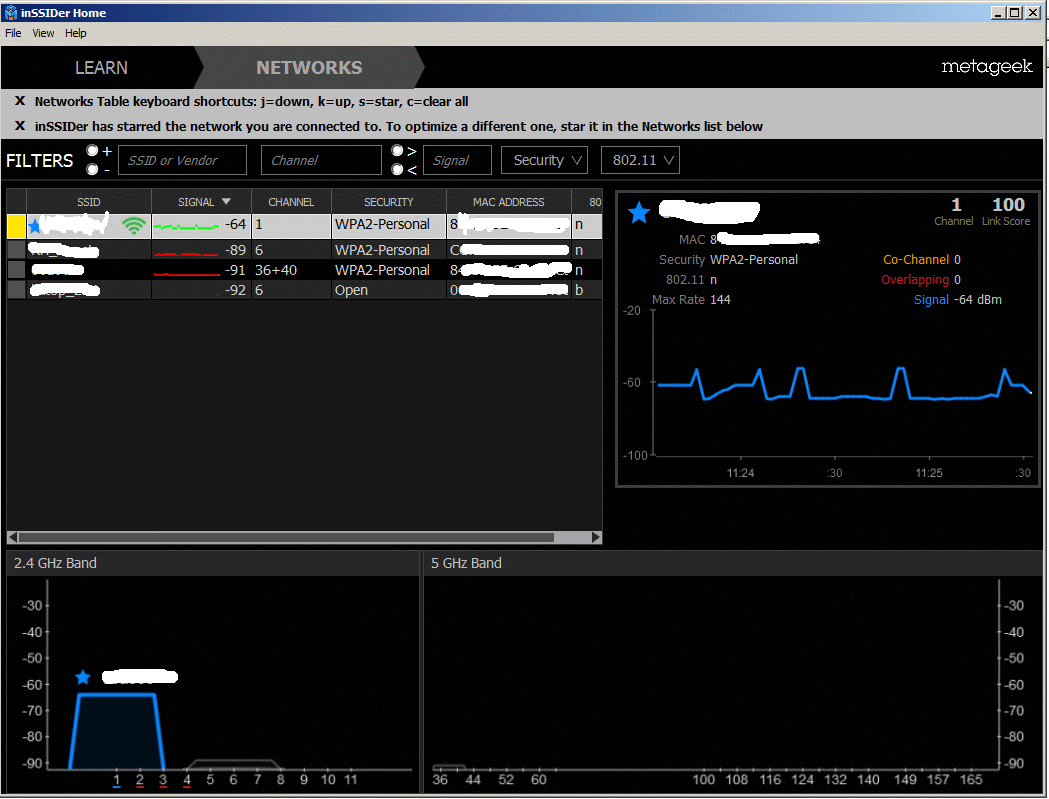
    To see if that channel 9 pollution was coming from the house,
    I downloaded InsSSIDer freeware for Windows & Android:
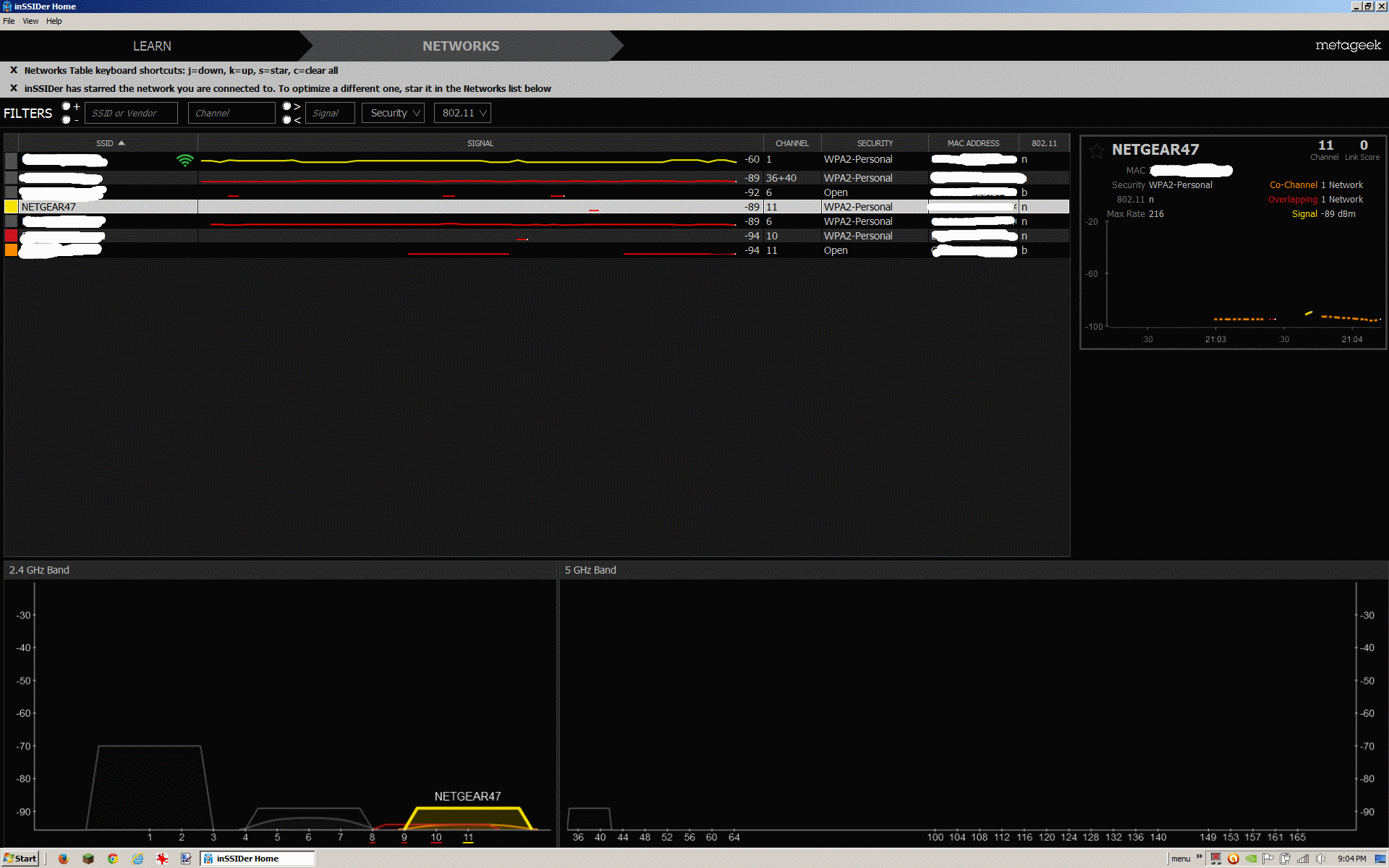
    http://www.metageek.net/products/inssider/

    Roaming the house, I could easily see my channel 1 home broadband
    router polluting channels 1 & 3; and I could see that 4 through
    8 had "something" on them at much lower levels; but 9 seemed clear:
    http://farm4.staticflickr.com/3774/11439214705_a722483f08_o.gif

    The caveat here is that the radio measures things from miles away
    while the Inssider program only measures what the absolutely puny
    antenna and crippled radio on the laptop (or Android phone) can
    see - which is miniscule.

    So, all I can tell from that is that the channel 9 interference
    isn't coming from *my* house! :)


    PS:
    I didn't stretch any of the screenshots, so, if they're stretched,
    Flickr did it, not me. :)
    --- Synchronet 3.21b-Linux NewsLink 1.2
  • From Jeff Liebermann@jeffl@cruzio.com to alt.home.repair,alt.internet.wireless,alt.ham-radio on Wed Dec 18 14:01:21 2013
    From Newsgroup: alt.ham-radio

    On Wed, 18 Dec 2013 10:20:04 -0900, "Bill Bradshaw" <bradshaw@gci.net>
    wrote:

    "Jeff Liebermann" <jeffl@cruzio.com> wrote in message >news:kg52b91u1ijsr8mitn3ea0mjfi358n1arr@4ax.com...
    On Wed, 18 Dec 2013 02:21:53 +0000 (UTC), hh <hh@kk.org> wrote:

    only guy who can do this is gone, Jeff Liebermann

    Rumors of my demise might be a bit premature. I'm buried in projects,
    work, Christmas Chrisis', ladyfriend, and trying to untrash my house,
    office, and vehicle. Incidentally, this is what I've been doing for
    "fun".
    <http://www.learnbydestroying.com/jeffl/antennas/dish-move-project/>

    Lady friend means untrash house. You should have thought about this
    :-).

    Nope. It was my idea. I spent my first 50 years or so accumulating
    all this junk. I'll probably spend another 50 years or so getting rid
    of it. Do I really need 5 bicycles? I'm making weekly runs to the
    recyclers, thrift shop, or municipal dump to get rid of the stuff. (I
    really miss my pickup truck). At my present rate, I should have the
    house and office cleaned up in about 50 years.
    --
    Jeff Liebermann jeffl@cruzio.com
    150 Felker St #D http://www.LearnByDestroying.com
    Santa Cruz CA 95060 http://802.11junk.com
    Skype: JeffLiebermann AE6KS 831-336-2558
    --- Synchronet 3.21b-Linux NewsLink 1.2
  • From ps56k@pschuman_no5pam_m3@interserv.com to alt.home.repair,alt.internet.wireless,alt.ham-radio on Wed Dec 18 17:14:59 2013
    From Newsgroup: alt.ham-radio

    my friend just retired and moved from a huge custom house in the cold,
    snowy, Chicago area
    down to the middle of FL - sitting out on the lanai....

    He coined the term ---> de-crapification

    Just prior to his leaving, we had our little college ski group lunch
    gathering (4 guys)
    with him presenting us each with a token from our past as part of his de-crapification.
    Some were FORTRAN puch cards, from our CS days,
    some were check/receipts from our skiiing in Austria,
    some were photos from frat parties - with fuzzy hair and long sideburns.


    --- Synchronet 3.21b-Linux NewsLink 1.2
  • From Char Jackson@none@none.invalid to alt.home.repair,alt.internet.wireless,alt.ham-radio on Wed Dec 18 21:50:34 2013
    From Newsgroup: alt.ham-radio

    On Wed, 18 Dec 2013 19:18:38 +0000 (UTC), "Danny D." <dannyd@nowhere.com> wrote:

    On Wed, 18 Dec 2013 08:59:51 -0800, Jeff Liebermann wrote:

    Why is your WISP using Ch 10. Is there a problem with Ch 11 or does
    he have his AP setup for the dreaded "auto"?

    Hmmm.... I don't have a clue as to the answer. All I know is
    that he had texted me how to set up my radio, and I set it up
    just like he had texted me to. I just looked at the settings
    in the radio, and I see the channel width set to 20MHz and
    channel shifting disabled, but I don't see where the channel
    is actually set.

    Your equipment is the client, so you don't get to set the channel. The WISP sets the channel and all you can do is follow their lead.

    --- Synchronet 3.21b-Linux NewsLink 1.2
  • From Danny D.@dannyd@nowhere.com to alt.home.repair,alt.internet.wireless,alt.ham-radio on Thu Dec 19 04:35:25 2013
    From Newsgroup: alt.ham-radio

    On Wed, 18 Dec 2013 21:50:34 -0600, Char Jackson wrote:

    Your equipment is the client, so you don't get to set the channel.
    The WISP sets the channel and all you can do is follow their lead.

    Thanks for clarifying that.
    I had poured over every page of the router setup, and I
    didn't see WHERE the channel was set.

    I did see the channel width, and modulation, but, not
    the channel itself.

    You explained why that is.

    Thanks!

    What I love about this WiFi gear is that we can connect to
    an access point five miles away, and it works as well as if
    the access point was in the next bedroom over!
    --- Synchronet 3.21b-Linux NewsLink 1.2
  • From The Daring Dufas@the-daring-dufas@stinky-finger.net to alt.home.repair,alt.internet.wireless,alt.ham-radio on Wed Dec 18 22:59:04 2013
    From Newsgroup: alt.ham-radio

    On 12/18/2013 5:14 PM, ps56k wrote:
    my friend just retired and moved from a huge custom house in the cold,
    snowy, Chicago area
    down to the middle of FL - sitting out on the lanai....

    He coined the term ---> de-crapification

    Just prior to his leaving, we had our little college ski group lunch gathering (4 guys)
    with him presenting us each with a token from our past as part of his de-crapification.
    Some were FORTRAN puch cards, from our CS days,
    some were check/receipts from our skiiing in Austria,
    some were photos from frat parties - with fuzzy hair and long sideburns.


    When I was in college you could spot a nerd because he had a pocket
    protector and a rectangular box of punch cards under one arm. Pocket calculators came out later, cost around $400.00 and had nerds drooling
    over them. I was out of college when I saw my first HP calculator but I
    still had boxes of punch cards. ^_^

    TDD

    --- Synchronet 3.21b-Linux NewsLink 1.2
  • From Jeff Liebermann@jeffl@cruzio.com to alt.home.repair,alt.internet.wireless,alt.ham-radio on Thu Dec 19 08:30:25 2013
    From Newsgroup: alt.ham-radio

    On Wed, 18 Dec 2013 22:59:04 -0600, The Daring Dufas <the-daring-dufas@stinky-finger.net> wrote:

    When I was in college you could spot a nerd because he had a pocket >protector and a rectangular box of punch cards under one arm. Pocket >calculators came out later, cost around $400.00 and had nerds drooling
    over them. I was out of college when I saw my first HP calculator but I >still had boxes of punch cards. ^_^

    Yeah, that was the theory but it didn't quite work at Cal Poly Pomona
    in the late 1960's. Among other divisions, Cal Poly had an
    engineering skool and an ABM (agricultural business management) skool.
    One would assume that the engineering students carried slide rules and
    punched cards, and the ABM students looked like TV cowboys. Nope. The engineering students wanted to look like cowboys and wore boots,
    jeans, flannel, but not the hat. The ABM students wore suits, ties,
    hats, and carried briefcases. There was also a skool of environmental
    design, which true to the stereotype, everyone looked like hippies. I
    tried to make sense of it at the time, and gave up.

    Incidentally, it took me about 10 years to work my way through all the
    punched card decks I had accumulated and used mostly as scratch paper.
    I didn't make the same mistake with paper tape, which I converted to
    floppy and burned the tapes.

    My first calculator was an analog computer that I built into a brief
    case. There were several 10 turn pots to input the numbers, and a big
    mirrored meter to read the output. Basically, an electronic
    implementation of a slide rule. <https://groups.google.com/forum/#!original/scruz.general/Egv8cT2-JGY/SNVk9zi1ULQJ>

    When I graduated from college, I could throw everything I owned into
    my pickup truck and drive off into the sunset (and actually did that a
    few times). If I tried that today, it would take at least two large
    moving vans and a project manager.

    He who dies with the most toys, wins.
    --
    Jeff Liebermann jeffl@cruzio.com
    150 Felker St #D http://www.LearnByDestroying.com
    Santa Cruz CA 95060 http://802.11junk.com
    Skype: JeffLiebermann AE6KS 831-336-2558
    --- Synchronet 3.21b-Linux NewsLink 1.2
  • From krw@krw@attt.bizz to alt.home.repair,alt.internet.wireless,alt.ham-radio on Thu Dec 19 12:13:37 2013
    From Newsgroup: alt.ham-radio

    On Wed, 18 Dec 2013 22:59:04 -0600, The Daring Dufas <the-daring-dufas@stinky-finger.net> wrote:

    On 12/18/2013 5:14 PM, ps56k wrote:
    my friend just retired and moved from a huge custom house in the cold,
    snowy, Chicago area
    down to the middle of FL - sitting out on the lanai....

    He coined the term ---> de-crapification

    Just prior to his leaving, we had our little college ski group lunch
    gathering (4 guys)
    with him presenting us each with a token from our past as part of his
    de-crapification.
    Some were FORTRAN puch cards, from our CS days,
    some were check/receipts from our skiiing in Austria,
    some were photos from frat parties - with fuzzy hair and long sideburns.


    When I was in college you could spot a nerd because he had a pocket >protector and a rectangular box of punch cards under one arm. Pocket >calculators came out later, cost around $400.00 and had nerds drooling
    over them. I was out of college when I saw my first HP calculator but I >still had boxes of punch cards. ^_^

    Punch cards were for the CS weenies. ;-) The real nerds had
    slip-stick scabbards hanging from their belts (I carried mine with my
    books). Over my senior year, the slip-sticks were being replaced by calculators (and holsters for scabbards ;-). I bought an HP, and yes,
    it was $400 (about 10-weeks gross pay).
    --- Synchronet 3.21b-Linux NewsLink 1.2
  • From The Daring Dufas@the-daring-dufas@stinky-finger.net to alt.home.repair,alt.internet.wireless,alt.ham-radio on Thu Dec 19 11:26:01 2013
    From Newsgroup: alt.ham-radio

    On 12/19/2013 10:30 AM, Jeff Liebermann wrote:
    On Wed, 18 Dec 2013 22:59:04 -0600, The Daring Dufas <the-daring-dufas@stinky-finger.net> wrote:

    When I was in college you could spot a nerd because he had a
    pocket protector and a rectangular box of punch cards under one
    arm. Pocket calculators came out later, cost around $400.00 and had
    nerds drooling over them. I was out of college when I saw my first
    HP calculator but I still had boxes of punch cards. ^_^

    Yeah, that was the theory but it didn't quite work at Cal Poly
    Pomona in the late 1960's. Among other divisions, Cal Poly had an engineering skool and an ABM (agricultural business management)
    skool. One would assume that the engineering students carried slide
    rules and punched cards, and the ABM students looked like TV cowboys.
    Nope. The engineering students wanted to look like cowboys and wore
    boots, jeans, flannel, but not the hat. The ABM students wore suits,
    ties, hats, and carried briefcases. There was also a skool of
    environmental design, which true to the stereotype, everyone looked
    like hippies. I tried to make sense of it at the time, and gave up.

    Incidentally, it took me about 10 years to work my way through all
    the punched card decks I had accumulated and used mostly as scratch
    paper. I didn't make the same mistake with paper tape, which I
    converted to floppy and burned the tapes.

    My first calculator was an analog computer that I built into a brief
    case. There were several 10 turn pots to input the numbers, and a
    big mirrored meter to read the output. Basically, an electronic implementation of a slide rule. <https://groups.google.com/forum/#!original/scruz.general/Egv8cT2-JGY/SNVk9zi1ULQJ>

    When I graduated from college, I could throw everything I owned
    into my pickup truck and drive off into the sunset (and actually did
    that a few times). If I tried that today, it would take at least two
    large moving vans and a project manager.

    He who dies with the most toys, wins.


    Here in Alabamastan we actually have a state college, The University of
    Auburn, which is both the premier agricultural and engineering school. I traveled to Auburn one year to visit some friends and drove past "The
    Swine Research Unit". The smell could gag a maggot but the pigs were
    happy. In the mid 1960's at The University of Alabama, I started playing
    with and learning a tiny bit of Basic and Fortran in order to play with
    the Univac which was on its way out and the new IBM 360/50 RAX system
    which was replacing it. Kids these days have no idea how user friendly computers are now compared to what I started playing with like the
    analog computer at my school but I really believe computers were more
    fun all those years ago. Now they're tools, not so exclusive anymore and
    any kids gaming computer has much more computing power than what was
    considered a super computer at one time. ^_^

    TDD
    --- Synchronet 3.21b-Linux NewsLink 1.2
  • From Danny D.@dannyd@nowhere.com to alt.home.repair,alt.internet.wireless,alt.ham-radio on Thu Dec 19 17:42:09 2013
    From Newsgroup: alt.ham-radio

    On Wed, 18 Dec 2013 18:51:01 -0800, miso wrote:

    You can by RF shield spray at Frys. Not cheap, well at least compared to
    a can of spray paint.

    Huh? Wow. I had never heard of that, for antennas & reflectors.
    Hmmm... I've seen it on the inside of monitors I've disassembled, especially the white ones (where the inside is a scratchy gray painted color).

    Hmmmmm..... so what would I paint?

    I guess I'd paint the backside of the Rocketdish reflector.
    Would I also paint the outside of the Rocket M2 radio unit?
    I guess I could also paint the CAT5 cable coming into the rocket.

    Oooops. I just realized, I did NOT use shielded cable for my cat5.
    I used indoor plenum stuff. I wonder if shielded cable would have
    made a difference?
    --- Synchronet 3.21b-Linux NewsLink 1.2
  • From The Daring Dufas@the-daring-dufas@stinky-finger.net to alt.home.repair,alt.internet.wireless,alt.ham-radio on Thu Dec 19 11:45:23 2013
    From Newsgroup: alt.ham-radio

    On 12/19/2013 11:13 AM, krw@attt.bizz wrote:
    On Wed, 18 Dec 2013 22:59:04 -0600, The Daring Dufas <the-daring-dufas@stinky-finger.net> wrote:

    On 12/18/2013 5:14 PM, ps56k wrote:
    my friend just retired and moved from a huge custom house in the cold,
    snowy, Chicago area
    down to the middle of FL - sitting out on the lanai....

    He coined the term ---> de-crapification

    Just prior to his leaving, we had our little college ski group lunch
    gathering (4 guys)
    with him presenting us each with a token from our past as part of his
    de-crapification.
    Some were FORTRAN puch cards, from our CS days,
    some were check/receipts from our skiiing in Austria,
    some were photos from frat parties - with fuzzy hair and long sideburns. >>>

    When I was in college you could spot a nerd because he had a pocket
    protector and a rectangular box of punch cards under one arm. Pocket
    calculators came out later, cost around $400.00 and had nerds drooling
    over them. I was out of college when I saw my first HP calculator but I
    still had boxes of punch cards. ^_^

    Punch cards were for the CS weenies. ;-) The real nerds had
    slip-stick scabbards hanging from their belts (I carried mine with my
    books). Over my senior year, the slip-sticks were being replaced by calculators (and holsters for scabbards ;-). I bought an HP, and yes,
    it was $400 (about 10-weeks gross pay).

    Oh I had a slide rule too. It was a K&E as I remember and I wish I still
    had it. ^_^

    TDD
    --- Synchronet 3.21b-Linux NewsLink 1.2
  • From Danny D.@dannyd@nowhere.com to alt.home.repair,alt.internet.wireless,alt.ham-radio on Thu Dec 19 17:52:59 2013
    From Newsgroup: alt.ham-radio

    On Wed, 18 Dec 2013 09:19:56 -0800, Jeff Liebermann wrote:

    http://farm8.staticflickr.com/7299/11427414296_de48f3922e_o.jpg

    Looks like you have interference from someone nearby using Ch 9.

    I'm still amazed that you saw that, lurking inside the graphs!

    You must have eyes like an eagle, because I had not seen it
    (until you pointed it out).

    Although, for the life of me, I can't determine the *source*
    of that channel 9 interference since nothing inside the house
    or nearby seems to have a strong enough signal to register as
    channel 9 WiFi...

    For example, here is a scan on my laptop for access points:
    http://farm8.staticflickr.com/7364/11445566476_38a0cdf3b1_o.gif

    Nothing is on channel 9.

    Here is a scan of the access points from my radio:
    http://farm6.staticflickr.com/5484/11427682854_0332590c4f_o.png

    So, I do agree with you that there is a good amount of channel
    9 interference; but I must conclude the source of that noise
    is distant (but clearly in the path of the radio).

    --- Synchronet 3.21b-Linux NewsLink 1.2
  • From Danny D.@dannyd@nowhere.com to alt.home.repair,alt.internet.wireless,alt.ham-radio on Thu Dec 19 17:54:45 2013
    From Newsgroup: alt.ham-radio

    On Thu, 19 Dec 2013 11:45:23 -0600, The Daring Dufas wrote:

    Oh I had a slide rule too. It was a K&E as I remember and
    I wish I still had it. ^_^

    My Dad, bless his heart, taught me how to use a slide rule
    when I was in high school trig class. His was bamboo and white,
    as I remember it. He bought me a smaller one, and I cherished
    it. I hope I still have it, but, I've moved a half dozen times
    since so it's somewhere.

    --- Synchronet 3.21b-Linux NewsLink 1.2
  • From Danny D.@dannyd@nowhere.com to alt.home.repair,alt.internet.wireless,alt.ham-radio on Thu Dec 19 18:10:24 2013
    From Newsgroup: alt.ham-radio

    On Wed, 18 Dec 2013 19:44:34 -0800, Jeff Liebermann wrote:

    Unplug your antenna and see what manner of "noise" level you get.
    You should replace the antenna with a 50 ohm terminator.
    That's easy if there's an antenna connector available.

    Hmmm... this always confuses me, as to what is the radio, what
    is the antenna, and what is "just" a reflector.

    I have three radios, one of which is on the (tile) roof, so, that's
    the hard one to get to.
    a. Rocket M2 + Rocketdish (rooftop antenna connected to my WISP).
    b. Nanobridge M2 + dish reflector (I have this in my hand right now).
    c. Bullet M2 + planar antenna (this is mounted on a pole outside).

    In the case of the Bullet M2, it's clear the 27dBm (600mW) radio
    is a wholly separate unit than whatever antenna you attach to it:
    http://store.netgate.com/Ubiquiti-Bullet-M2-HP-80211bgN-600mW-IndoorOutdoor-CPE-P71.aspx

    It's less clear in the case of the Nanobridge M2, where the "feedhorn"
    is actually a 23dBm (200mW) radio + integral 3dBi antenna, but, where
    the radio+antenna comes already attached to the 15dBi reflector.
    http://www.solidsignal.com/pview.asp?p=nb-2g18&d=ubiquiti-nanobridge-m2-18-outdoor-mimo-2.4ghz-wireless-bridge-18dbi-%28nb2g18%29

    It's unclear to me which is the antenna and which is the reflector
    in the case of the Rocket M2 + Rocketdish:
    ROCKET M2: http://store.netgate.com/Ubiquiti-Rocket-M2-24GHz-80211N-MIMO-PtP-PtMP-P287C128.aspx
    ROCKETDISH: http://store.netgate.com/RocketDish-2G-24-24GHz-AirMax-2x2-PtP-Bridge-Dish-Antenna-P1727.aspx

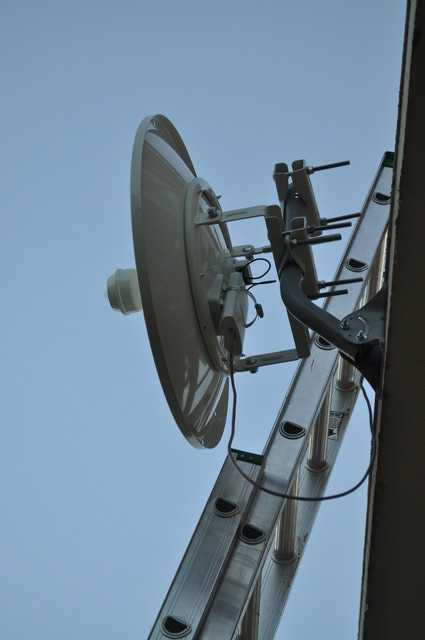
    Is that "thing" at the end of the feedhorn on the Rocketdish the
    antenna? Or is the antenna elsewhere?
    --- Synchronet 3.21b-Linux NewsLink 1.2
  • From Tony Hwang@dragon40@shaw.ca to alt.home.repair,alt.internet.wireless,alt.ham-radio on Thu Dec 19 11:37:31 2013
    From Newsgroup: alt.ham-radio

    Danny D. wrote:
    On Thu, 19 Dec 2013 11:45:23 -0600, The Daring Dufas wrote:

    Oh I had a slide rule too. It was a K&E as I remember and
    I wish I still had it. ^_^

    My Dad, bless his heart, taught me how to use a slide rule
    when I was in high school trig class. His was bamboo and white,
    as I remember it. He bought me a smaller one, and I cherished
    it. I hope I still have it, but, I've moved a half dozen times
    since so it's somewhere.

    Hi,
    I still have mine in a leather case on my study desk shelf.
    --- Synchronet 3.21b-Linux NewsLink 1.2
  • From Tony Hwang@dragon40@shaw.ca to alt.home.repair,alt.internet.wireless,alt.ham-radio on Thu Dec 19 11:35:15 2013
    From Newsgroup: alt.ham-radio

    The Daring Dufas wrote:
    On 12/19/2013 10:30 AM, Jeff Liebermann wrote:
    On Wed, 18 Dec 2013 22:59:04 -0600, The Daring Dufas
    <the-daring-dufas@stinky-finger.net> wrote:

    When I was in college you could spot a nerd because he had a
    pocket protector and a rectangular box of punch cards under one
    arm. Pocket calculators came out later, cost around $400.00 and
    had nerds drooling over them. I was out of college when I saw my
    first HP calculator but I still had boxes of punch cards. ^_^

    Yeah, that was the theory but it didn't quite work at Cal Poly
    Pomona in the late 1960's. Among other divisions, Cal Poly had an
    engineering skool and an ABM (agricultural business management)
    skool. One would assume that the engineering students carried
    slide rules and punched cards, and the ABM students looked like TV
    cowboys. Nope. The engineering students wanted to look like cowboys
    and wore boots, jeans, flannel, but not the hat. The ABM students
    wore suits, ties, hats, and carried briefcases. There was also a
    skool of environmental design, which true to the stereotype,
    everyone looked like hippies. I tried to make sense of it at the
    time, and gave up.

    Incidentally, it took me about 10 years to work my way through all
    the punched card decks I had accumulated and used mostly as
    scratch paper. I didn't make the same mistake with paper tape,
    which I converted to floppy and burned the tapes.

    My first calculator was an analog computer that I built into a
    brief case. There were several 10 turn pots to input the numbers,
    and a big mirrored meter to read the output. Basically, an
    electronic implementation of a slide rule.
    <https://groups.google.com/forum/#!original/scruz.general/Egv8cT2-JGY/SNVk9zi1ULQJ>


    When I graduated from college, I could throw everything I owned
    into my pickup truck and drive off into the sunset (and actually
    did that a few times). If I tried that today, it would take at
    least two large moving vans and a project manager.

    He who dies with the most toys, wins.


    Here in Alabamastan we actually have a state college, The University
    of Auburn, which is both the premier agricultural and engineering
    school. I traveled to Auburn one year to visit some friends and drove
    past "The Swine Research Unit". The smell could gag a maggot but the
    pigs were happy. In the mid 1960's at The University of Alabama, I
    started playing with and learning a tiny bit of Basic and Fortran in
    order to play with the Univac which was on its way out and the new
    IBM 360/50 RAX system which was replacing it. Kids these days have no
    idea how user friendly computers are now compared to what I started
    playing with like the analog computer at my school but I really
    believe computers were more fun all those years ago. Now they're
    tools, not so exclusive anymore and any kids gaming computer has much
    more computing power than what was considered a super computer at one
    time. ^_^

    TDD
    Hi,
    You guys are little bit behind me, when I was into it during and after
    school, computers were called electronic calculator as such containing
    vacuum tubes, mechanical relays.. from there transistors, small scale IC
    all the way into nanotech which is now. I used to use blank punch card
    with columms and rows all half pre-punched so we can push the confetti
    out to make holes where we want to do Fortran programming. If you drop
    the card deck by accident, you have to resort one by one to make them in
    proper order before you can have it read. Also remember 51 column card?
    Credit card receipts were 51 column card size which could be read after
    they are punched by key punch operators(girls) reading the amount
    written and imprinted account number. My Ham radio hobby was from the
    '50s, licensed in '60. Hold Extra U.S., Advanced/Digital Canadian,
    First class Korean licenses. Right now I am busy resetting up our HT
    system into 7.1 with new AV receiver and speakers. Better be done before X-mas.
    --- Synchronet 3.21b-Linux NewsLink 1.2
  • From The Daring Dufas@the-daring-dufas@stinky-finger.net to alt.home.repair,alt.internet.wireless,alt.ham-radio on Thu Dec 19 13:35:46 2013
    From Newsgroup: alt.ham-radio

    On 12/19/2013 12:35 PM, Tony Hwang wrote:
    The Daring Dufas wrote:
    On 12/19/2013 10:30 AM, Jeff Liebermann wrote:
    On Wed, 18 Dec 2013 22:59:04 -0600, The Daring Dufas
    <the-daring-dufas@stinky-finger.net> wrote:

    When I was in college you could spot a nerd because he had a
    pocket protector and a rectangular box of punch cards under
    one arm. Pocket calculators came out later, cost around $400.00
    and had nerds drooling over them. I was out of college when I
    saw my first HP calculator but I still had boxes of punch
    cards. ^_^

    Yeah, that was the theory but it didn't quite work at Cal Poly
    Pomona in the late 1960's. Among other divisions, Cal Poly had
    an engineering skool and an ABM (agricultural business
    management) skool. One would assume that the engineering students
    carried slide rules and punched cards, and the ABM students
    looked like TV cowboys. Nope. The engineering students wanted to
    look like cowboys and wore boots, jeans, flannel, but not the
    hat. The ABM students wore suits, ties, hats, and carried
    briefcases. There was also a skool of environmental design,
    which true to the stereotype, everyone looked like hippies. I
    tried to make sense of it at the time, and gave up.

    Incidentally, it took me about 10 years to work my way through
    all the punched card decks I had accumulated and used mostly as
    scratch paper. I didn't make the same mistake with paper tape,
    which I converted to floppy and burned the tapes.

    My first calculator was an analog computer that I built into a
    brief case. There were several 10 turn pots to input the
    numbers, and a big mirrored meter to read the output. Basically,
    an electronic implementation of a slide rule.
    <https://groups.google.com/forum/#!original/scruz.general/Egv8cT2-JGY/SNVk9zi1ULQJ>


    When I graduated from college, I could throw everything I owned
    into my pickup truck and drive off into the sunset (and actually
    did that a few times). If I tried that today, it would take at
    least two large moving vans and a project manager.

    He who dies with the most toys, wins.


    Here in Alabamastan we actually have a state college, The
    University of Auburn, which is both the premier agricultural and
    engineering school. I traveled to Auburn one year to visit some
    friends and drove past "The Swine Research Unit". The smell could
    gag a maggot but the pigs were happy. In the mid 1960's at The
    University of Alabama, I started playing with and learning a tiny
    bit of Basic and Fortran in order to play with the Univac which was
    on its way out and the new IBM 360/50 RAX system which was
    replacing it. Kids these days have no idea how user friendly
    computers are now compared to what I started playing with like the
    analog computer at my school but I really believe computers were
    more fun all those years ago. Now they're tools, not so exclusive
    anymore and any kids gaming computer has much more computing power
    than what was considered a super computer at one time. ^_^

    TDD
    Hi, You guys are little bit behind me, when I was into it during and
    after school, computers were called electronic calculator as such
    containing vacuum tubes, mechanical relays.. from there transistors,
    small scale IC all the way into nanotech which is now. I used to use
    blank punch card with columms and rows all half pre-punched so we can
    push the confetti out to make holes where we want to do Fortran
    programming. If you drop the card deck by accident, you have to
    resort one by one to make them in proper order before you can have it
    read. Also remember 51 column card? Credit card receipts were 51
    column card size which could be read after they are punched by key
    punch operators(girls) reading the amount written and imprinted
    account number. My Ham radio hobby was from the '50s, licensed in
    '60. Hold Extra U.S., Advanced/Digital Canadian, First class Korean
    licenses. Right now I am busy resetting up our HT system into 7.1
    with new AV receiver and speakers. Better be done before X-mas.

    We must pass our knowledge and skills on to a younger generation because
    they are being lost. If our modern society crashed, most people would be helpless because they have no idea how older simpler technology
    works. Perhaps Boy Scouts could help people survive? o_O

    TDD
    --- Synchronet 3.21b-Linux NewsLink 1.2
  • From Danny D.@dannyd@nowhere.com to alt.home.repair,alt.internet.wireless,alt.ham-radio on Thu Dec 19 19:44:30 2013
    From Newsgroup: alt.ham-radio

    On Thu, 19 Dec 2013 11:37:31 -0700, Tony Hwang wrote:

    I still have mine in a leather case on my study desk shelf.

    Save that forever!

    I still have some 8" floppy disks!

    My kids were amazed.

    I'm saving them for the grandkids, but, they never saw
    so-called (hard sided) floppies ... so it might not make
    as much an impact on them.
    --- Synchronet 3.21b-Linux NewsLink 1.2
  • From Jeff Liebermann@jeffl@cruzio.com to alt.home.repair,alt.internet.wireless,alt.ham-radio on Thu Dec 19 11:48:35 2013
    From Newsgroup: alt.ham-radio

    On Thu, 19 Dec 2013 12:13:37 -0500, krw@attt.bizz wrote:

    Punch cards were for the CS weenies. ;-) The real nerds had
    slip-stick scabbards hanging from their belts (I carried mine with my
    books). Over my senior year, the slip-sticks were being replaced by >calculators (and holsters for scabbards ;-). I bought an HP, and yes,
    it was $400 (about 10-weeks gross pay).

    Ditto. Despite the briefcase analog computer contrivance, the grunt
    work was done with a 6" K&E. <http://www.LearnByDestroying.com/jeffl/pics/slide-rule/slides/slide-rule.html> The one in the photo is what I used a half century ago. (Hmm... why
    am I suddenly feeling old?) I still use a slide rule for doing gear
    ratios. I also give occasional demos of the slide rule to kids that
    have never seen one. Incidentally, I give a song and dance on using a
    nautical sextant in a few minutes... oops, I'm late.
    --
    Jeff Liebermann jeffl@cruzio.com
    150 Felker St #D http://www.LearnByDestroying.com
    Santa Cruz CA 95060 http://802.11junk.com
    Skype: JeffLiebermann AE6KS 831-336-2558
    --- Synchronet 3.21b-Linux NewsLink 1.2
  • From krw@krw@attt.bizz to alt.home.repair,alt.internet.wireless,alt.ham-radio on Thu Dec 19 16:50:17 2013
    From Newsgroup: alt.ham-radio

    On Thu, 19 Dec 2013 11:45:23 -0600, The Daring Dufas <the-daring-dufas@stinky-finger.net> wrote:

    On 12/19/2013 11:13 AM, krw@attt.bizz wrote:
    On Wed, 18 Dec 2013 22:59:04 -0600, The Daring Dufas
    <the-daring-dufas@stinky-finger.net> wrote:

    On 12/18/2013 5:14 PM, ps56k wrote:
    my friend just retired and moved from a huge custom house in the cold, >>>> snowy, Chicago area
    down to the middle of FL - sitting out on the lanai....

    He coined the term ---> de-crapification

    Just prior to his leaving, we had our little college ski group lunch
    gathering (4 guys)
    with him presenting us each with a token from our past as part of his
    de-crapification.
    Some were FORTRAN puch cards, from our CS days,
    some were check/receipts from our skiiing in Austria,
    some were photos from frat parties - with fuzzy hair and long sideburns. >>>>

    When I was in college you could spot a nerd because he had a pocket
    protector and a rectangular box of punch cards under one arm. Pocket
    calculators came out later, cost around $400.00 and had nerds drooling
    over them. I was out of college when I saw my first HP calculator but I
    still had boxes of punch cards. ^_^

    Punch cards were for the CS weenies. ;-) The real nerds had
    slip-stick scabbards hanging from their belts (I carried mine with my
    books). Over my senior year, the slip-sticks were being replaced by
    calculators (and holsters for scabbards ;-). I bought an HP, and yes,
    it was $400 (about 10-weeks gross pay).

    Oh I had a slide rule too. It was a K&E as I remember and I wish I still
    had it. ^_^

    Mine is a Post Versalog. I still have it, as well as the HP-45 that
    had its 40th birthday last month. ;-)
    --- Synchronet 3.21b-Linux NewsLink 1.2
  • From The Daring Dufas@the-daring-dufas@stinky-finger.net to alt.home.repair,alt.internet.wireless,alt.ham-radio on Thu Dec 19 21:58:05 2013
    From Newsgroup: alt.ham-radio

    On 12/19/2013 3:50 PM, krw@attt.bizz wrote:
    On Thu, 19 Dec 2013 11:45:23 -0600, The Daring Dufas <the-daring-dufas@stinky-finger.net> wrote:

    On 12/19/2013 11:13 AM, krw@attt.bizz wrote:
    On Wed, 18 Dec 2013 22:59:04 -0600, The Daring Dufas
    <the-daring-dufas@stinky-finger.net> wrote:

    On 12/18/2013 5:14 PM, ps56k wrote:
    my friend just retired and moved from a huge custom house in the cold, >>>>> snowy, Chicago area
    down to the middle of FL - sitting out on the lanai....

    He coined the term ---> de-crapification

    Just prior to his leaving, we had our little college ski group lunch >>>>> gathering (4 guys)
    with him presenting us each with a token from our past as part of his >>>>> de-crapification.
    Some were FORTRAN puch cards, from our CS days,
    some were check/receipts from our skiiing in Austria,
    some were photos from frat parties - with fuzzy hair and long sideburns. >>>>>

    When I was in college you could spot a nerd because he had a pocket
    protector and a rectangular box of punch cards under one arm. Pocket
    calculators came out later, cost around $400.00 and had nerds drooling >>>> over them. I was out of college when I saw my first HP calculator but I >>>> still had boxes of punch cards. ^_^

    Punch cards were for the CS weenies. ;-) The real nerds had
    slip-stick scabbards hanging from their belts (I carried mine with my
    books). Over my senior year, the slip-sticks were being replaced by
    calculators (and holsters for scabbards ;-). I bought an HP, and yes,
    it was $400 (about 10-weeks gross pay).

    Oh I had a slide rule too. It was a K&E as I remember and I wish I still
    had it. ^_^

    Mine is a Post Versalog. I still have it, as well as the HP-45 that
    had its 40th birthday last month. ;-)


    Oh man, the HP-45 cost as much back then as a desktop computer costs
    now. ^_^

    TDD
    --- Synchronet 3.21b-Linux NewsLink 1.2
  • From krw@krw@attt.bizz to alt.home.repair,alt.internet.wireless,alt.ham-radio on Thu Dec 19 23:34:36 2013
    From Newsgroup: alt.ham-radio

    On Thu, 19 Dec 2013 21:58:05 -0600, The Daring Dufas <the-daring-dufas@stinky-finger.net> wrote:

    On 12/19/2013 3:50 PM, krw@attt.bizz wrote:
    On Thu, 19 Dec 2013 11:45:23 -0600, The Daring Dufas
    <the-daring-dufas@stinky-finger.net> wrote:

    On 12/19/2013 11:13 AM, krw@attt.bizz wrote:
    On Wed, 18 Dec 2013 22:59:04 -0600, The Daring Dufas
    <the-daring-dufas@stinky-finger.net> wrote:

    On 12/18/2013 5:14 PM, ps56k wrote:
    my friend just retired and moved from a huge custom house in the cold, >>>>>> snowy, Chicago area
    down to the middle of FL - sitting out on the lanai....

    He coined the term ---> de-crapification

    Just prior to his leaving, we had our little college ski group lunch >>>>>> gathering (4 guys)
    with him presenting us each with a token from our past as part of his >>>>>> de-crapification.
    Some were FORTRAN puch cards, from our CS days,
    some were check/receipts from our skiiing in Austria,
    some were photos from frat parties - with fuzzy hair and long sideburns. >>>>>>

    When I was in college you could spot a nerd because he had a pocket
    protector and a rectangular box of punch cards under one arm. Pocket >>>>> calculators came out later, cost around $400.00 and had nerds drooling >>>>> over them. I was out of college when I saw my first HP calculator but I >>>>> still had boxes of punch cards. ^_^

    Punch cards were for the CS weenies. ;-) The real nerds had
    slip-stick scabbards hanging from their belts (I carried mine with my
    books). Over my senior year, the slip-sticks were being replaced by
    calculators (and holsters for scabbards ;-). I bought an HP, and yes, >>>> it was $400 (about 10-weeks gross pay).

    Oh I had a slide rule too. It was a K&E as I remember and I wish I still >>> had it. ^_^

    Mine is a Post Versalog. I still have it, as well as the HP-45 that
    had its 40th birthday last month. ;-)


    Oh man, the HP-45 cost as much back then as a desktop computer costs
    now. ^_^

    The HP-45 was $395 in 1973 but very different dollars. About 50x
    different, for me.

    --- Synchronet 3.21b-Linux NewsLink 1.2
  • From The Daring Dufas@the-daring-dufas@stinky-finger.net to alt.home.repair,alt.internet.wireless,alt.ham-radio on Fri Dec 20 00:59:25 2013
    From Newsgroup: alt.ham-radio

    On 12/19/2013 10:34 PM, krw@attt.bizz wrote:
    On Thu, 19 Dec 2013 21:58:05 -0600, The Daring Dufas <the-daring-dufas@stinky-finger.net> wrote:

    On 12/19/2013 3:50 PM, krw@attt.bizz wrote:
    On Thu, 19 Dec 2013 11:45:23 -0600, The Daring Dufas
    <the-daring-dufas@stinky-finger.net> wrote:

    On 12/19/2013 11:13 AM, krw@attt.bizz wrote:
    On Wed, 18 Dec 2013 22:59:04 -0600, The Daring Dufas
    <the-daring-dufas@stinky-finger.net> wrote:

    On 12/18/2013 5:14 PM, ps56k wrote:
    my friend just retired and moved from a huge custom house in the cold, >>>>>>> snowy, Chicago area
    down to the middle of FL - sitting out on the lanai....

    He coined the term ---> de-crapification

    Just prior to his leaving, we had our little college ski group lunch >>>>>>> gathering (4 guys)
    with him presenting us each with a token from our past as part of his >>>>>>> de-crapification.
    Some were FORTRAN puch cards, from our CS days,
    some were check/receipts from our skiiing in Austria,
    some were photos from frat parties - with fuzzy hair and long sideburns.


    When I was in college you could spot a nerd because he had a pocket >>>>>> protector and a rectangular box of punch cards under one arm. Pocket >>>>>> calculators came out later, cost around $400.00 and had nerds drooling >>>>>> over them. I was out of college when I saw my first HP calculator but I >>>>>> still had boxes of punch cards. ^_^

    Punch cards were for the CS weenies. ;-) The real nerds had
    slip-stick scabbards hanging from their belts (I carried mine with my >>>>> books). Over my senior year, the slip-sticks were being replaced by >>>>> calculators (and holsters for scabbards ;-). I bought an HP, and yes, >>>>> it was $400 (about 10-weeks gross pay).

    Oh I had a slide rule too. It was a K&E as I remember and I wish I still >>>> had it. ^_^

    Mine is a Post Versalog. I still have it, as well as the HP-45 that
    had its 40th birthday last month. ;-)


    Oh man, the HP-45 cost as much back then as a desktop computer costs
    now. ^_^

    The HP-45 was $395 in 1973 but very different dollars. About 50x
    different, for me.


    That was a heck of a lot of money for me in those days considering
    minimum wage was $1.60/hr and I was paying 22 cents a gallon for regular
    at the San-Ann gas station. In 1971 I was working at a defense
    plant that made some munitions parts for the military and I was paid
    $1.68/hr because I was working 11pm to 7am. The 8 cents was called a
    shift differential paid to those who worked the night shift. ^_^

    The pot's been boiling for a long time and the frogs still haven't
    jumped out. o_O

    TDD
    --- Synchronet 3.21b-Linux NewsLink 1.2
  • From krw@krw@attt.bizz to alt.home.repair,alt.internet.wireless,alt.ham-radio on Fri Dec 20 20:50:23 2013
    From Newsgroup: alt.ham-radio

    On Fri, 20 Dec 2013 00:59:25 -0600, The Daring Dufas <the-daring-dufas@stinky-finger.net> wrote:

    On 12/19/2013 10:34 PM, krw@attt.bizz wrote:
    On Thu, 19 Dec 2013 21:58:05 -0600, The Daring Dufas
    <the-daring-dufas@stinky-finger.net> wrote:

    On 12/19/2013 3:50 PM, krw@attt.bizz wrote:
    On Thu, 19 Dec 2013 11:45:23 -0600, The Daring Dufas
    <the-daring-dufas@stinky-finger.net> wrote:

    On 12/19/2013 11:13 AM, krw@attt.bizz wrote:
    On Wed, 18 Dec 2013 22:59:04 -0600, The Daring Dufas
    <the-daring-dufas@stinky-finger.net> wrote:

    On 12/18/2013 5:14 PM, ps56k wrote:
    my friend just retired and moved from a huge custom house in the cold, >>>>>>>> snowy, Chicago area
    down to the middle of FL - sitting out on the lanai....

    He coined the term ---> de-crapification

    Just prior to his leaving, we had our little college ski group lunch >>>>>>>> gathering (4 guys)
    with him presenting us each with a token from our past as part of his >>>>>>>> de-crapification.
    Some were FORTRAN puch cards, from our CS days,
    some were check/receipts from our skiiing in Austria,
    some were photos from frat parties - with fuzzy hair and long sideburns.


    When I was in college you could spot a nerd because he had a pocket >>>>>>> protector and a rectangular box of punch cards under one arm. Pocket >>>>>>> calculators came out later, cost around $400.00 and had nerds drooling >>>>>>> over them. I was out of college when I saw my first HP calculator but I >>>>>>> still had boxes of punch cards. ^_^

    Punch cards were for the CS weenies. ;-) The real nerds had
    slip-stick scabbards hanging from their belts (I carried mine with my >>>>>> books). Over my senior year, the slip-sticks were being replaced by >>>>>> calculators (and holsters for scabbards ;-). I bought an HP, and yes, >>>>>> it was $400 (about 10-weeks gross pay).

    Oh I had a slide rule too. It was a K&E as I remember and I wish I still >>>>> had it. ^_^

    Mine is a Post Versalog. I still have it, as well as the HP-45 that
    had its 40th birthday last month. ;-)


    Oh man, the HP-45 cost as much back then as a desktop computer costs
    now. ^_^

    The HP-45 was $395 in 1973 but very different dollars. About 50x
    different, for me.


    That was a heck of a lot of money for me in those days considering
    minimum wage was $1.60/hr and I was paying 22 cents a gallon for regular
    at the San-Ann gas station. In 1971 I was working at a defense
    plant that made some munitions parts for the military and I was paid
    $1.68/hr because I was working 11pm to 7am. The 8 cents was called a
    shift differential paid to those who worked the night shift. ^_^

    It was my senior year in college. The minimum wage was $2.00/hr and I
    only worked 20hrs/wk (all they would give me during the school year).
    It's a good thing a glass of beer was only $.25. ;-)

    The pot's been boiling for a long time and the frogs still haven't
    jumped out. o_O

    They're gettin' antsy, though.
    --- Synchronet 3.21b-Linux NewsLink 1.2
  • From Danny D.@dannyd@nowhere.com to alt.home.repair,alt.internet.wireless,alt.ham-radio on Sat Dec 21 04:17:06 2013
    From Newsgroup: alt.ham-radio

    On Fri, 20 Dec 2013 19:24:55 -0800, makolber wrote:

    Also decrease the feed line loss...
    Is the radio mounted up at the antenna?

    Hi Mark,

    Here is a picture of the mount when I had installed it:
    http://farm4.staticflickr.com/3688/11474128726_aa955239ba_o.jpg

    The radio itself is the classic Ubiquiti Rocket M2:
    http://store.netgate.com/Assets/ProductImages/ROCKETM2%20US.jpg

    That radio is clipped directly onto the back of the dish:
    http://www.ubntstore.eu/images/detailed/0/tmp_FEWrpH.jpg

    One mistake I made was to use non-shielded cable, so,
    there's about 75 feet of the plenum stuff outside going
    from the roof to the first floor office where the
    router and POE lie.

    From a practical (noise) standpoint, how much do you think
    that matters?

    --- Synchronet 3.21b-Linux NewsLink 1.2
  • From Tony Hwang@dragon40@shaw.ca to alt.home.repair,alt.internet.wireless,alt.ham-radio on Fri Dec 20 21:54:28 2013
    From Newsgroup: alt.ham-radio

    Danny D. wrote:
    On Fri, 20 Dec 2013 19:24:55 -0800, makolber wrote:

    Also decrease the feed line loss...
    Is the radio mounted up at the antenna?

    Hi Mark,

    Here is a picture of the mount when I had installed it:
    http://farm4.staticflickr.com/3688/11474128726_aa955239ba_o.jpg

    The radio itself is the classic Ubiquiti Rocket M2:
    http://store.netgate.com/Assets/ProductImages/ROCKETM2%20US.jpg

    That radio is clipped directly onto the back of the dish:
    http://www.ubntstore.eu/images/detailed/0/tmp_FEWrpH.jpg

    One mistake I made was to use non-shielded cable, so,
    there's about 75 feet of the plenum stuff outside going
    from the roof to the first floor office where the
    router and POE lie.

    From a practical (noise) standpoint, how much do you think
    that matters?

    Hi,
    B4 you ask that question think about shield? Why do you think we use
    shielded cable in AF or RF cabling(wiring) CAT 7 spec. ethernet cable is
    best one.
    I believe your noise is radio related unlikely Ethernet cable related.
    Looks like your radio is repeater? All in all if you have reliable
    connection, what's the worry? One way of increasing signal strength
    will be using a bigger dish or did you picked best height of the
    antenna. The higher the better is a myth. Is it LOS install.?

    Way back when I was working on microwave, troposcatter links biggest
    one was troposcatter link shooting from Nha Trang, S, Vietnam over to Thailand. Triple diversity, antenna was 120 ft. square parabolic pair.
    Nitrogen gas filled wave guides were used. No coax. SWR was around 1.2.
    One night VC rocket sharpnels made some holes in wave guides plumbing,
    SWR went upto about 1.4

    Tri diversity is based on antenna spacing, frequency, polarization.
    RX was parametric cavity tuned preamp, and all tube based RX, TX was 10W
    TWT exciter to 10KW water cooled Klystron driving 100KW bigger Klystron
    also with water cooled. HV on them were around 27KV DC.

    This all became obsolete soon when RCA launched first Commsat. That was
    end of my career in RF telecomm. going into Digital Data comm, main
    frames, etc. Worked on autovon/autodin, Arpanet(origin of Internet).
    Now I am no good any more, things changing too fast to grasp all.

    --- Synchronet 3.21b-Linux NewsLink 1.2
  • From Danny D'Amico@dannyd@is.invalid to alt.home.repair,alt.internet.wireless,alt.ham-radio on Sat Dec 21 07:19:50 2013
    From Newsgroup: alt.ham-radio

    On Fri, 20 Dec 2013 21:54:28 -0700, Tony Hwang wrote:

    B4 you ask that question think about shield? Why do you think we use shielded cable in AF or RF cabling

    I think the shielding shorts out EMI/RFI interference; but, if that interference is, say 60Hz, it won't be the cause of my noise.

    My noise is at 2.4GHz.

    So, I *think* the shielding isn't really shielding against *my* noise.
    But it could shield against 60Hz noise (which I'm not measuring).

    That's what I think - but I don't really know the answer...

    --- Synchronet 3.21b-Linux NewsLink 1.2
  • From Danny D'Amico@dannyd@is.invalid to alt.home.repair,alt.internet.wireless,alt.ham-radio on Sat Dec 21 07:29:25 2013
    From Newsgroup: alt.ham-radio

    On Fri, 20 Dec 2013 21:54:28 -0700, Tony Hwang wrote:

    Looks like your radio is repeater? All in all if you have reliable connection, what's the worry? One way of increasing signal strength
    will be using a bigger dish or did you picked best height of the
    antenna. The higher the better is a myth. Is it LOS install.?

    Hi Tony,

    The radio is not set up as a repeater. It's set up as a router:
    http://farm8.staticflickr.com/7380/11427771814_de0692ea50_o.png

    As you noted, I do have a reliable connection to the 2.4GHz WiFi
    access point about 3 miles away, but, since my service is unthrottled,
    the lower I can get noise, the faster I can get the speeds!

    For example, here are side-by-side screenshots of the Rocket M2
    speeds versus the Nanobridge M2 speeds the day I switched them out:
    http://farm8.staticflickr.com/7448/11475595375_740ac269e1_o.png

    Notice, with *nothing* changed other than the dish & radio, on the
    smaller Nanobridge, I got 78Mbps but on the larger Rocket, I got 117Mbps.

    I don't really want to go *bigger* than the Rocketdish, so, that's
    why I'm asking how to lower the noise.

    Note: I see the noise on the Nanobridge was -97dBm, and that of the
    Rocket is -89dBm, so, it's interesting that the Rocket is noiser than
    the Nanobridge, considering the beamwidth of the Rocket is far narrower
    (but the gain is far higher).

    --- Synchronet 3.21b-Linux NewsLink 1.2
  • From Danny D'Amico@dannyd@is.invalid to alt.home.repair,alt.internet.wireless,alt.ham-radio on Sat Dec 21 07:51:35 2013
    From Newsgroup: alt.ham-radio

    On Sat, 21 Dec 2013 07:29:25 +0000, Danny D'Amico wrote:

    I don't really want to go *bigger* than the Rocketdish, so, that's
    why I'm asking how to lower the noise.

    I should explain that, while I can *fit* a bigger unit on my roof,
    the RocketDish is already 24dBi and the Rocket M2 radio is already
    28dBm, so, the maximum (claimed) gain is 52 dBi (158 Watts), while
    the maximum legal gain is 36dBm (4 Watts), so, the Rocket is already
    throttling itself automatically just to keep within legal limits.

    So I don't think a bigger dish is really the solution.

    The solution is to figure out how to lower the noise...and,
    the RF Armor seems to be the best answer (albeit pricey).
    --- Synchronet 3.21b-Linux NewsLink 1.2
  • From Tony Hwang@dragon40@shaw.ca to alt.home.repair,alt.internet.wireless,alt.ham-radio on Sat Dec 21 00:58:27 2013
    From Newsgroup: alt.ham-radio

    Danny D'Amico wrote:
    On Fri, 20 Dec 2013 21:54:28 -0700, Tony Hwang wrote:

    Looks like your radio is repeater? All in all if you have reliable
    connection, what's the worry? One way of increasing signal strength
    will be using a bigger dish or did you picked best height of the
    antenna. The higher the better is a myth. Is it LOS install.?

    Hi Tony,

    The radio is not set up as a repeater. It's set up as a router:
    http://farm8.staticflickr.com/7380/11427771814_de0692ea50_o.png

    As you noted, I do have a reliable connection to the 2.4GHz WiFi
    access point about 3 miles away, but, since my service is unthrottled,
    the lower I can get noise, the faster I can get the speeds!

    For example, here are side-by-side screenshots of the Rocket M2
    speeds versus the Nanobridge M2 speeds the day I switched them out:
    http://farm8.staticflickr.com/7448/11475595375_740ac269e1_o.png

    Notice, with *nothing* changed other than the dish & radio, on the
    smaller Nanobridge, I got 78Mbps but on the larger Rocket, I got 117Mbps.

    I don't really want to go *bigger* than the Rocketdish, so, that's
    why I'm asking how to lower the noise.

    Note: I see the noise on the Nanobridge was -97dBm, and that of the
    Rocket is -89dBm, so, it's interesting that the Rocket is noiser than
    the Nanobridge, considering the beamwidth of the Rocket is far narrower
    (but the gain is far higher).

    Hi,
    What is operating power of the two radios and what is the sensitivity of
    two RX? They are built on same design specs? Is it real LOS install
    or radio horizon install?
    --- Synchronet 3.21b-Linux NewsLink 1.2
  • From Tony Hwang@dragon40@shaw.ca to alt.home.repair,alt.internet.wireless,alt.ham-radio on Sat Dec 21 01:02:42 2013
    From Newsgroup: alt.ham-radio

    Danny D'Amico wrote:
    On Sat, 21 Dec 2013 07:29:25 +0000, Danny D'Amico wrote:

    I don't really want to go *bigger* than the Rocketdish, so, that's
    why I'm asking how to lower the noise.

    I should explain that, while I can *fit* a bigger unit on my roof,
    the RocketDish is already 24dBi and the Rocket M2 radio is already
    28dBm, so, the maximum (claimed) gain is 52 dBi (158 Watts), while
    the maximum legal gain is 36dBm (4 Watts), so, the Rocket is already throttling itself automatically just to keep within legal limits.

    So I don't think a bigger dish is really the solution.

    The solution is to figure out how to lower the noise...and,
    the RF Armor seems to be the best answer (albeit pricey).

    Hi,
    If you rfeally hae to there iss no such thing as this the problem and
    this is solution. You need many hours "cut and try type approach". First
    off like using best cables you can get, even POE injectors are not
    created equal.

    --- Synchronet 3.21b-Linux NewsLink 1.2
  • From Danny D'Amico@danny@is.invalid to alt.home.repair,alt.internet.wireless,alt.ham-radio on Sat Dec 21 10:38:06 2013
    From Newsgroup: alt.ham-radio

    On Sat, 21 Dec 2013 00:58:27 -0700, Tony Hwang wrote:

    What is operating power of the two radios and what is the sensitivity of
    two RX? They are built on same design specs? Is it real LOS install
    or radio horizon install?

    Hi Tony,

    The access point is a bit more than 3 miles away, line of sight.
    http://farm8.staticflickr.com/7448/11475595375_740ac269e1_o.png

    NANOBRIDGE M2:
    Measured signal strength = -68 dBm
    Measured noise floor = -97 dBm
    Measured speed = 78 Mbps / 52 Mbps (i.e., 2-channel MIMO)
    Claimed transmit power = 23 dBm (max)
    Claimed antenna gain = 18 dBi
    Calculated EIRP = 41 dBm (12 Watts)
    Claimed sensitivity = -93 dBm (max)
    SPEC: http://dl.ubnt.com/datasheets/nanobridgem/nbm_ds_web.pdf

    ROCKET M2 + ROCKETDISH 2G-24:
    Measured signal strength = -64 dBm
    Measured noise floor = -89 dBm
    Measured speed = 117 Mbps / 117 Mbps (i.e., 2-channel MIMO)
    Claimed transmit power = 28 dBm (max)
    Claimed antenna gain = 24 dBi
    Calculated EIRP = 52 dBm (158 Watts)
    Claimed sensitivity = -95dBm (max)
    SPEC: https://www.discomp.cz/img.asp?attid=88929

    --- Synchronet 3.21b-Linux NewsLink 1.2
  • From Danny D'Amico@dannyd@is.invalid to alt.home.repair,alt.internet.wireless,alt.ham-radio on Sat Dec 21 10:41:01 2013
    From Newsgroup: alt.ham-radio

    On Sat, 21 Dec 2013 01:02:42 -0700, Tony Hwang wrote:

    even POE injectors are not created equal.

    Hi Tony,
    With my cabling all less than 100 feet, it really doesn't
    matter what POE I use with my three radios.

    My Bullet came with a half amp 15 volt POE, and my
    Nanobridge came with an amp 24 volt POE, and my
    Rocket came with an amp 24 volt POE with its own
    reset switch (which is really handy since the rocket
    is on the roof).

    In practice, since my cabling is so short, the POE
    does not matter, as far as I can tell.

    Something else *does* matter though ... :)
    --- Synchronet 3.21b-Linux NewsLink 1.2
  • From The Daring Dufas@the-daring-dufas@stinky-finger.net to alt.home.repair,alt.internet.wireless,alt.ham-radio on Sat Dec 21 04:50:49 2013
    From Newsgroup: alt.ham-radio

    On 12/20/2013 10:54 PM, Tony Hwang wrote:
    Danny D. wrote:
    On Fri, 20 Dec 2013 19:24:55 -0800, makolber wrote:

    Also decrease the feed line loss... Is the radio mounted up at
    the antenna?

    Hi Mark,

    Here is a picture of the mount when I had installed it:
    http://farm4.staticflickr.com/3688/11474128726_aa955239ba_o.jpg

    The radio itself is the classic Ubiquiti Rocket M2:
    http://store.netgate.com/Assets/ProductImages/ROCKETM2%20US.jpg

    That radio is clipped directly onto the back of the dish:
    http://www.ubntstore.eu/images/detailed/0/tmp_FEWrpH.jpg

    One mistake I made was to use non-shielded cable, so, there's about
    75 feet of the plenum stuff outside going from the roof to the
    first floor office where the router and POE lie.

    From a practical (noise) standpoint, how much do you think that
    matters?

    Hi, B4 you ask that question think about shield? Why do you think we
    use shielded cable in AF or RF cabling(wiring) CAT 7 spec. ethernet
    cable is best one. I believe your noise is radio related unlikely
    Ethernet cable related. Looks like your radio is repeater? All in all
    if you have reliable connection, what's the worry? One way of
    increasing signal strength will be using a bigger dish or did you
    picked best height of the antenna. The higher the better is a myth.
    Is it LOS install.?

    Way back when I was working on microwave, troposcatter links biggest
    one was troposcatter link shooting from Nha Trang, S, Vietnam over to
    Thailand. Triple diversity, antenna was 120 ft. square parabolic
    pair. Nitrogen gas filled wave guides were used. No coax. SWR was
    around 1.2. One night VC rocket sharpnels made some holes in wave
    guides plumbing, SWR went upto about 1.4

    Tri diversity is based on antenna spacing, frequency, polarization.
    RX was parametric cavity tuned preamp, and all tube based RX, TX was
    10W TWT exciter to 10KW water cooled Klystron driving 100KW bigger
    Klystron also with water cooled. HV on them were around 27KV DC.

    This all became obsolete soon when RCA launched first Commsat. That
    was end of my career in RF telecomm. going into Digital Data comm,
    main frames, etc. Worked on autovon/autodin, Arpanet(origin of
    Internet). Now I am no good any more, things changing too fast to
    grasp all.


    Nonsense, when you quit learning you're dead. You know how to learn
    which is a quality many people lack. ^_^

    TDD
    --- Synchronet 3.21b-Linux NewsLink 1.2